AI resume screening: how machine learning finds the best candidates
AI resume screening explained for recruiters: how machine learning parses, scores, and ranks candidates fairly, plus the bias and compliance traps.


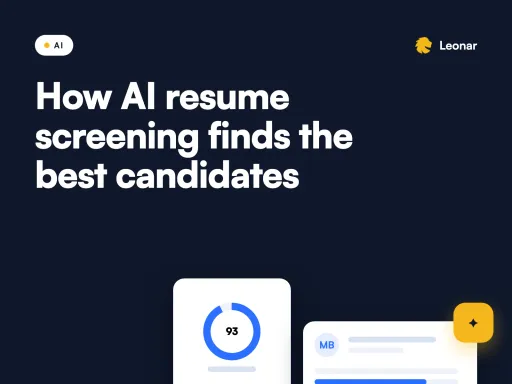
AI resume screening uses machine learning to read an application, understand the role, and rank candidates by fit. It does not just count keywords. The good versions read context: career path, skill overlap, the scope someone owned. The result is a ranked shortlist with reasoning. You get it in minutes, not days.
That promise carries a real fear too. Every recruiter has heard the horror story. A strong candidate gets dropped because a dumb filter missed one word. So this guide gives you the honest version. What AI screening does well. Where it quietly fails. What the law now expects. And how to use it without handing your judgment to a machine.
What AI resume screening actually is (and what it is not)
AI resume screening is software that reads job applications and ranks them by fit. It uses machine learning and natural language processing instead of fixed rules. It turns a messy PDF into structured data. Then it compares that data to what the role needs and tells you who looks most promising.
Here is what it is not. It is not the old keyword filter that recruiters rightly distrust. A keyword filter checks whether a resume contains exact strings, like “project management” or “Python”. It buries anything that does not. It cannot tell that “led a 12-person delivery team” means project management. Machine learning can.
The difference matters, because the two get lumped together. When people say “the ATS rejected me”, they usually mean a blunt keyword screen. They do not mean a context-aware model. Knowing which one you are buying changes how much you should trust the output.
Keyword matching vs machine learning: the difference recruiters feel
The clearest way to see the gap is side by side. Keyword matching is mechanical. Machine learning reads for meaning. One looks for words. The other looks for evidence.
| Keyword filter (legacy ATS) | AI resume screening (machine learning) | |
|---|---|---|
| What it reads | Exact words and phrases | Meaning, context, career trajectory |
| How it ranks | Match count against a list | Fit score against the whole role |
| Synonyms and paraphrase | Missed unless spelled out | Understood (“led delivery” = project management) |
| Risk | Drops strong candidates on wording | Over-trust if used as auto-reject |
| Output | Pass or fail | Ranked shortlist with reasoning |
| Transparency | A hidden cutoff | A score you can inspect and question |
A keyword filter forces candidates to guess the right wording. A good machine learning model reads what they actually did. So context-aware screening often surfaces people a keyword screen would have lost. That is the opposite of the reputation these tools carry. Screening is only one job these platforms handle; our guide to the best AI recruiting tools covers sourcing, screening, and outreach in one place.
If you want screening built into a full hiring pipeline, our comparison of the best applicant tracking systems covers screening features, pricing, buyer profiles, and workflow fit.
How AI resume screening works, step by step
Under the hood, most modern systems follow the same four moves. None of them is magic, and understanding the sequence helps you spot where things can go wrong.
First, the system parses the resume. It reads the PDF and pulls out structured fields: job titles, dates, employers, skills, education, locations. This is where unusual formatting causes trouble. A model can only score what it managed to read.
Second, it builds an understanding of the role. Sometimes this comes straight from the job description. Better setups let you define an ideal candidate profile. Then the model knows that “5 years in B2B SaaS sales” matters more than one specific certificate.
Third, it scores and ranks. The model compares each candidate to the role and gives a fit score. Usually it shows the reasoning behind it. You get a shortlist sorted by relevance, not a folder of 600 PDFs in the order they arrived.
Fourth, the best systems learn. When you advance or reject candidates, the model picks up your real preferences and adjusts. The screen you get in week one is generic. The one you get a month later is sharper, because it has watched how your team decides.
What the AI is really scoring (it is not counting keywords)
People assume the model rewards buzzwords. Modern systems do the opposite. They look for signal under the words.
Career trajectory is a big one. Someone who moved from analyst to lead in four years tells a different story than someone who held the same title for a decade. A context-aware model reads that arc. Skill adjacency matters too. The system can tell that a person who ran paid acquisition probably understands attribution, even if they never wrote the word.
Scope and seniority signals carry weight. Managing a budget, owning a region, or shipping a product is stronger evidence than a list of tools. The model weighs what someone was responsible for, not just what they claim to know. This is also why honest, specific resumes beat keyword-stuffed ones. Padding a document no longer games a system that reads for evidence.
Where AI screening gets it wrong: false negatives and edge cases
No honest guide skips this part. AI screening fails in predictable ways, and knowing them is how you stay in control.
Non-traditional paths are the classic blind spot. Career changers, military veterans, bootcamp graduates, and parents returning to work often have the skills. They just lack the tidy resume shape a model learned to expect. If the training data leaned toward linear careers, these candidates can score low for the wrong reasons.
Formatting still trips parsers. A two-column layout, a resume saved as an image, or heavy use of tables can scramble the parse step. A candidate the model never properly read cannot be ranked fairly.
Over-trust is the other failure mode, and it is human, not technical. A tired recruiter treats the top of the list as gospel and never scrolls down. Then the tool stops being an assistant and becomes a gatekeeper. The fix is simple to say and harder to practice. The AI ranks. The recruiter decides.
Bias and fairness: the part nobody should skip
AI does not remove bias by default. It learns from history, and hiring history is not neutral. The most cited example is Amazon’s experimental screening tool. It was scrapped after it penalized resumes containing the word “women’s”. The model had learned from a decade of male-skewed hiring. It did not invent the bias. It absorbed it.
So why use AI at all for something this sensitive? Because a well-monitored system can also be fairer than a tired human. It applies the same criteria to every candidate, at 9am and at 6pm, on application one and application 400. And unlike a gut call, a scored decision leaves an audit trail you can inspect.
That only holds if you watch it. Fairness with AI screening is an active practice, not a setting you switch on. Audit outcomes across groups. Keep a human reviewing the borderline cases. Treat any model that cannot explain its scoring as a red flag, not a convenience.
Is AI resume screening legal? EU AI Act and NYC Local Law 144
This is where most guides go quiet. It is also where European agencies, our core readers, have the most questions. The short version: AI hiring tools are now regulated, and the rules are getting stricter.
In Europe, the EU AI Act classifies AI used in recruitment and candidate evaluation as high-risk. That brings duties around risk management, data quality, human oversight, transparency, and record-keeping. These apply to the systems that screen or rank applicants. If you operate in the EU, this is not optional fine print.
Across the Atlantic, New York City’s Local Law 144 has been in force since July 2023. It covers employers using an automated employment decision tool. You must commission an independent bias audit, publish a summary of the results, and tell candidates an automated tool is being used. Other places are drafting similar rules.
You do not need to be a lawyer to act on this. Ask any screening vendor three questions. Can it explain its scoring? Has it been audited for bias? Does it keep a human in the loop on real decisions? If a tool cannot answer those, the risk sits with you, not the vendor.
Screening is one stage, not the whole job: the sourcing-to-outreach loop
Here is the reframe most articles miss. Screening inbound applications and ranking sourced candidates are the same problem. The same AI solves both. A profile might arrive through your careers page, or you might find it while searching. Either way, the model does one thing. It reads a candidate and scores fit against a role.
When screening lives inside the same system that sources and runs outreach, the work stops being a set of disconnected steps. That is the practical edge of an AI-native recruiting platform over a legacy ATS. The legacy tool bolted a keyword filter onto a manual engine. Here, screening is not a separate tool you wired in. It is the same ranking layer that powers AI profile filtering and scoring on the candidates you go out and find.
Leonar works this way. Its application review reads each inbound application and scores it from 0 to 100. It gives a clear fit recommendation. It breaks the score down by criterion, so you see the reasoning, not just the number.
The same ranking runs on profiles you source from a database of more than 870 million. An agency handling both inbound and outbound never switches tools to ask the same question. For the wider picture, our breakdown of how AI sourcing compares to traditional recruiting covers the sourcing half of the loop.
How to roll out AI resume screening without losing trust
Adopting screening well is mostly about restraint. The teams that get burned are the ones that flip it to full auto on day one. Once you have a ranked shortlist, you still interview the top names, and an interview scorecard template for recruiters turns each conversation into evidence rather than a gut call. From there, a candidate submission template helps you carry that human judgment through to the client.
Start where the volume hurts most. High-application roles are where ranking saves the most time. A missed candidate also stings less there, because you still have hundreds more. Calibrate before you trust. Run the model next to your manual process for a week. Check whether its top picks match yours, then adjust the role profile until they do.
Keep humans on the decisions that matter. Use the score to sort and prioritize, never to send an automatic rejection. Monitor outcomes by group so bias cannot creep in unnoticed. Lean on recruiting automation for the mechanical steps, and let people keep the judgment calls. Finally, tell candidates you use an automated tool. It is increasingly required by law. It also builds the trust that a faster process can otherwise erode.
Which AI screening approach fits your team?
The right setup depends on who you are. High-volume in-house teams are drowning in applications. They get the most from screening that ranks and summarizes at scale. Recruiters then spend their hours on the top of the list instead of the whole pile.
Agencies and search firms have a different need. They juggle inbound applications and active sourcing at once. So the real win is one AI that scores both, inside one system. That is the case for a connected platform over a standalone screening widget. It is why so many recruitment agencies consolidate rather than stack point tools.
Wherever you land, the principle holds. AI resume screening is a powerful way to prioritize and a poor way to reject. Used as an assistant, it gives you back hours. It also gives you a fairer, more consistent first pass. If you want to see screening and sourcing scored in the same place, you can explore how Leonar scores applications and sourced profiles and try it free for seven days.
Frequently asked questions about AI resume screening
How does AI resume screening work?
It works in four steps. First, it parses a resume into structured data like titles, skills, and dates. Second, it learns the role from the job description or an ideal candidate profile. Third, it scores and ranks each candidate by fit, usually with reasoning. Fourth, the best systems learn from your accept and reject calls, so the screen gets sharper. The output is a ranked shortlist, not a pass-fail gate. That is what separates modern screening from old keyword filters.
Is AI resume screening accurate?
It is accurate at what it is built for. That means ranking large volumes consistently and surfacing strong matches under time pressure. It is weaker on unusual career paths, career changers, and resumes with messy formatting that breaks the parsing step. Accuracy leans heavily on calibration and on a human reviewing the results. Treat the score as a well-informed opinion that speeds up your judgment. Do not treat it as a verdict.
Does AI resume screening reject good candidates?
It should not, if you set it up right. A good system prioritizes candidates rather than rejecting them. It produces a ranked list a recruiter still reviews. The danger appears when teams wire the score to an automatic rejection. Then a parsing error or an unusual background can drop a strong candidate, and no human ever sees them. The safe rule is simple. Use AI screening to sort and shortlist. Keep every real rejection in human hands.
What is the difference between an ATS keyword filter and AI screening?
A keyword filter checks whether a resume contains exact words from a list. It discards the rest. It cannot understand synonyms or context. So “led a delivery team” will not register as project management unless those exact words appear. AI resume screening uses machine learning instead. It reads meaning, career trajectory, and skill overlap, then ranks candidates by fit. The filter is mechanical and binary. The AI is interpretive and shows a score you can inspect.
Is AI resume screening biased or illegal?
Bias is a genuine risk, because models learn from past hiring data that may not be neutral. It is not illegal, but it is increasingly regulated. The EU AI Act classifies recruitment AI as high-risk, with duties around oversight and transparency. New York City’s Local Law 144 requires a bias audit, a published summary, and candidate notice. To stay safe, choose tools that can explain their scoring and have been audited. Then monitor outcomes across groups and keep a human on every final decision.
Can candidates trick AI resume screening?
Old keyword filters could be gamed by stuffing a resume with terms. Modern context-aware models are much harder to fool. They read for evidence and trajectory, not exact strings. So padding a document with buzzwords no longer helps. It can even hurt, by making the resume read as inflated. The best approach for candidates is the honest one. Write a clear, well-structured resume with specific, verifiable achievements. That is exactly what a context-aware model rewards.
Answer 3 quick questions and we will recommend the best option for your hiring workflow.
How large is your recruiting team?

Author
Pierre-Alexis ArdonCo-founder
Pierre-Alexis Ardon is co-founder of Leonar, where he focuses on building AI-powered recruiting systems, assisted sourcing, and search optimization. With a background in engineering and over 7 years working at the intersection of artificial intelligence and talent acquisition, he designs the algorithms that power Leonar's candidate matching and workflow assistance. Pierre-Alexis advises recruitment agencies on their digital transformation and regularly publishes analyses on how AI agents are reshaping HR workflows. He is passionate about making advanced technology accessible to recruiters who are not engineers.
Related articles
-
 AI & Automation
How AI Is Transforming Executive Search
-
 AI & Automation
What does "AI-native ATS" really mean?
-
 AI & Automation
How to Use ChatGPT for Recruiting (2026)


