Bullhorn vs Recruiterflow: Which ATS fits your agency?
Bullhorn is the enterprise incumbent with deep VMS, Pay & Bill, and a 150+ integration marketplace. Recruiterflow is the modern mid-market sequencer with deep email and LinkedIn cadences and transparent pricing. Both serve recruiting agencies, but the trade-off is real: scale and compliance on one side, UX and outbound depth on the other. This guide breaks down where each tool wins and where each falls short.
Bullhorn vs Recruiterflow vs Leonar

Bullhorn
Legacy enterprise ATS and CRM for staffing agencies
Starting price
~$99/user/mo (custom quote required)
Best for
Large enterprise staffing firms with VMS and Pay & Bill needs
What we like
- Industry-standard VMS and Pay & Bill modules built for enterprise staffing
- 150+ integration marketplace covering job boards, background checks, onboarding
- Proven at scale with thousands of enterprise staffing firms in production
- Deep reporting and compliance analytics for regulated industries
- Established partner ecosystem with dedicated implementation consultants
Where it falls short
- Opaque pricing requires a sales call, with reported 15-20% renewal increases
- Legacy interface that feels dated next to modern recruiting tools
- Core AI requires paid add-ons (Bullhorn Automation, Textkernel, Copilot)
- Sourcing capture limited to basic profile viewing
- Long onboarding cycles, often 3-6 months for full deployment
Recruiterflow
The AI-first operating system for your recruiting business
Starting price
$149/user/mo
Best for
Recruiting and executive search agencies (5-50 recruiters)
What we like
- Industry-leading multi-step sequences across email and LinkedIn
- Transparent published pricing starting at $149/user/mo with no sales call
- AI email drafting tightly integrated into sequencing
- Modern, clean interface that recruiters can pick up in days
- Active power-user community sharing sequence templates
Where it falls short
- No VMS or Pay & Bill capabilities for temp and contract-heavy agencies
- Smaller integration marketplace than Bullhorn (around 40 vs 150+ integrations)
- Less proven at very large scale (200+ recruiter operations)
- No proprietary candidate database, sourcing requires extensions
- Reporting depth lighter than enterprise platforms expect
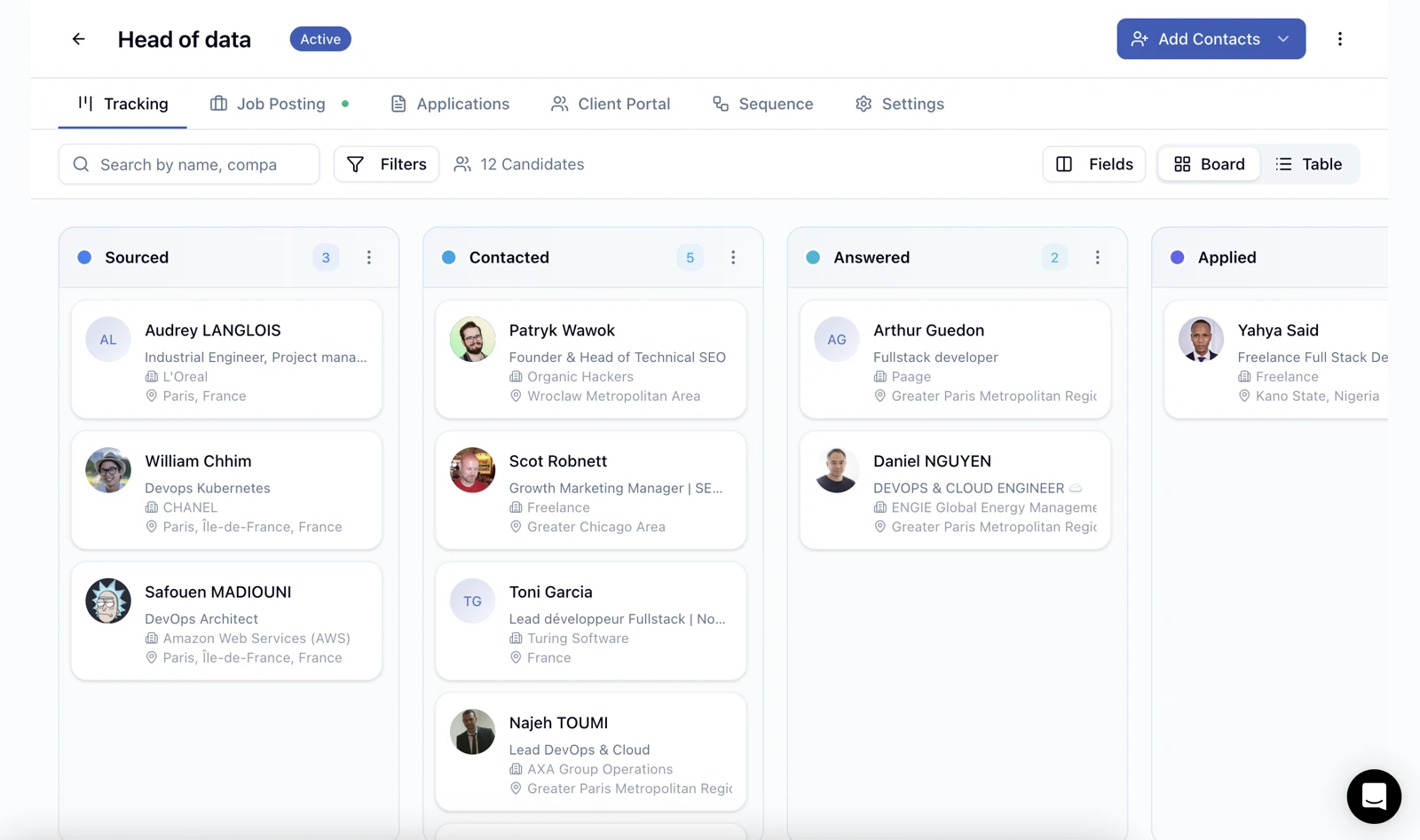

Leonar
Outbound recruiting teams and agencies that need sourcing, outreach, and CRM in one platform
- Transparent published pricing: $119/user/mo Starter, $199/user/mo Professional, no add-ons
- AI-assisted architecture: review selected records, prepare tasks and update your CRM after approval, not just generate text
- Sourcing workflow: organize selected records, review AI scoring and keep next actions visible
- Multichannel outreach with automated WhatsApp, email and SMS steps, plus LinkedIn reminders, from a unified inbox
Bullhorn vs Recruiterflow: Feature comparison
| Features | Bullhorn | Recruiterflow |
|---|---|---|
| Pricing & Transparency | ||
| Published pricing on website | ||
| Free trial available | ||
| No long-term contract required | ||
| Transparent renewal terms | ||
| All core features in base price | ||
| AI Capabilities | ||
| AI candidate matching | ||
| AI resume parsing | ||
| AI email and outreach drafting | ||
| AI sourcing agents | ||
| AI included in base tier | ||
| Customization & Workflow | ||
| Chrome extension for profile capture | ||
| Custom fields on contacts and companies | ||
| Custom pipeline stages | ||
| VMS integrations (Fieldglass, Beeline) | ||
| Pay & Bill module | ||
| Multi-step automation workflows | ||
| UX & Onboarding | ||
| Modern, intuitive interface | ||
| Self-serve onboarding (no consultant needed) | ||
| Mobile app | ||
| Average onboarding under 2 weeks | ||
| Drag-and-drop Kanban boards | ||
| Multichannel Outreach | ||
| Email sequences | ||
| LinkedIn reminders inside sequences | ||
| WhatsApp outreach | ||
| SMS outreach | ||
| Unified inbox across channels | ||
When to choose Bullhorn, Recruiterflow or Leonar
Choose Bullhorn if...
Choose Bullhorn if you run a large staffing operation that depends on temp or contract placements, needs VMS integrations like Fieldglass or Beeline, or requires Pay & Bill inside your ATS. Bullhorn is also the safer pick for enterprises that need a mature partner ecosystem, deep compliance reporting, and that are willing to invest in a 3-6 month implementation. If your placement volume is high and your processes are tightly coupled to existing enterprise systems, Bullhorn remains the industry default despite the higher total cost and dated interface.
Choose Recruiterflow if...
Choose Recruiterflow if you run a small to mid-sized agency (under 50 recruiters) that competes on outbound volume and wants a modern, transparent platform with deep email plus LinkedIn sequencing. The published pricing, fast onboarding, and active community make it sensible for direct-hire firms that have outgrown a basic ATS but do not need enterprise complexity. It is also a strong fit for agencies that want to operate the ATS as an outbound machine with custom workflows, rather than as a back-office system of record.
Choose Leonar if...
The Bullhorn versus Recruiterflow choice is essentially a generation gap. Bullhorn gives you enterprise infrastructure but locks you into opaque contracts, dated UX, and AI as a paid add-on. Recruiterflow gives you modern UX and deep sequences, but no enterprise scale and no sourcing database of its own. A growing number of agencies are no longer accepting that gap.
Leonar is an AI-native ATS and CRM built from the ground up for outbound recruiting teams. Pricing is published: $119/user/mo Starter and $199/user/mo Professional. The 870M+ profile sourcing database, multichannel workflows including WhatsApp, the Chrome extension for sourcing, and AI assistance for sourcing review, task preparation, and approved CRM updates are all included at the listed price. No add-ons, no sales call, no 3-6 month implementation.
Why modern agencies are choosing a third option
The Bullhorn versus Recruiterflow choice is essentially a generation gap. Bullhorn gives you enterprise infrastructure but locks you into opaque contracts, dated UX, and AI as a paid add-on. Recruiterflow gives you modern UX and deep sequences, but no enterprise scale and no sourcing database of its own. A growing number of agencies are no longer accepting that gap.
Leonar is an AI-native ATS and CRM built from the ground up for outbound recruiting teams. Pricing is published: $119/user/mo Starter and $199/user/mo Professional. The 870M+ profile sourcing database, multichannel workflows including WhatsApp, the Chrome extension for sourcing, and AI assistance for sourcing review, task preparation, and approved CRM updates are all included at the listed price. No add-ons, no sales call, no 3-6 month implementation.
The architectural difference matters. Leonar organizes the sourcing records your team selects, runs AI scoring review on them, and keeps the next actions visible in one place. Bullhorn has only basic profile viewing. Recruiterflow has a Chrome extension but no selected-record organization. For agencies producing shortlists every week, that gap is the difference between hours and minutes per shortlist.
What sets Leonar apart
- Transparent published pricing: $119/user/mo Starter, $199/user/mo Professional, no add-ons
- AI-assisted architecture: review selected records, prepare tasks and update your CRM after approval, not just generate text
- Sourcing workflow: organize selected records, review AI scoring and keep next actions visible
- Multichannel outreach with automated WhatsApp, email and SMS steps, plus LinkedIn reminders, from a unified inbox
- WhatsApp voice notes you can record from the desktop inbox, plus AI message variables generated per recipient at send time
- Self-serve onboarding in days, not months, with a modern interface for recruiters
Frequently asked questions
Is Bullhorn or Recruiterflow better for a small recruiting agency?
For agencies under 30 recruiters, Recruiterflow is usually the better fit. Bullhorn is engineered for enterprise staffing operations with long implementations, custom contracts, and a higher total cost. Recruiterflow offers published pricing starting at $149/user/mo, fast onboarding, and a modern interface that recruiters can adopt without a consultant. The exception: if your small agency runs heavy temp or contract placements that depend on VMS systems like Fieldglass, Bullhorn may still be necessary despite the overhead and slower deployment cycle.
Does Bullhorn have AI features comparable to Recruiterflow?
Not out of the box. Bullhorn offers AI capabilities through paid add-ons like Bullhorn Automation, Textkernel, and Copilot, which are separate products layered on top of the core platform. Recruiterflow has AI email drafting tightly integrated into its sequencing engine and offers AI candidate summaries on candidate records. Neither offers autonomous AI sourcing agents that find candidates without human input. The key difference is architectural: Recruiterflow integrates AI directly into recruiter workflows, while Bullhorn retrofits AI as separate paid modules.
Can I migrate my data from Bullhorn to Recruiterflow (or vice versa)?
Yes. Both platforms support data import via CSV and have API access on higher tiers. Migrating from Bullhorn to Recruiterflow typically requires exporting candidate records, job orders, placements, and notes, then mapping fields to the new system. Expect a 4-8 week project depending on data volume and the complexity of your custom fields. The migration in the other direction is rarer but follows a similar timeline. Many firms run both platforms in parallel during the transition to avoid disruption to active placements.
How do Bullhorn and Recruiterflow compare on getting candidate profiles into the ATS?
The two products differ mainly in how sourcing records reach the ATS. Bullhorn offers basic profile viewing. Recruiterflow ships a Chrome extension that captures individual profiles into the ATS, with partial Sales Navigator support. Neither is built to be the place where the sourcing search itself happens, so most agencies pair them with whichever sourcing tools they already run and use the ATS to manage what comes downstream.
What is the real cost of Bullhorn vs Recruiterflow per recruiter?
Bullhorn publishes Starter at $99 and Core at $165 per user per month but quotes its higher tiers, and agencies report add-on fees for automation, texting, and AI features that can push the total to $200+/user/mo. Renewal increases of 15-20% per year are common. Recruiterflow publishes its pricing transparently at $149/user/mo with higher tiers up to around $200/user/mo. At equivalent feature sets the platforms cost similar amounts, but Recruiterflow is upfront about pricing while Bullhorn requires a sales call. The advertised Bullhorn starting price rarely reflects the true cost of a fully-featured deployment.
Compare Leonar with other platforms
Leonar vs Bullhorn: AI-Native Recruiting or Legacy Staffing Stack?
Bullhorn was built for manual recruiting workflows in 1999. Leonar was built for AI-native recruiting from day one. Here is the honest head-to-head on pricing, AI depth, Sourcing Workflow Connector, and the onboarding experience your team actually lives with.
Detailed comparisonRecruiterflow vs Leonar: Which Recruiting Platform Wins in 2026?
Recruiterflow is built for agencies that rely on job postings and inbound applications, with deep job board distribution and pipeline management. Leonar is built for agencies that source proactively and engage candidates through direct outreach, with a built-in 870M+ profile database and native multi-channel sequences. Here is how they compare.
Bullhorn vs Loxo
Bullhorn is the enterprise incumbent with deep VMS and Pay & Bill capabilities. Loxo is the challenger with a massive talent database and AI sourcing agents. Both serve recruiting agencies, but they take fundamentally different approaches to the same problem. This guide breaks down where each tool excels, where it falls short, and who should pick which.
Recruit CRM vs Bullhorn
Recruit CRM is the modern mid-market all-in-one with published pricing and a clean interface. Bullhorn is the enterprise incumbent with deep VMS, Pay & Bill, and a 150+ integration marketplace. Both serve recruiting agencies, but the trade-off is real: ease and price on one side, scale and compliance on the other. This guide breaks down where each tool wins and where each falls short.
Loxo vs Recruiterflow
Loxo is the AI sourcing database with 850M+ profiles built into the ATS. Recruiterflow is the sequencing-first ATS with deep email and LinkedIn cadences. Both serve recruiting agencies, but they solve different ends of the funnel: Loxo helps you find candidates, Recruiterflow helps you engage them. Picking between the two is a choice about where your bottleneck lives. This guide breaks it down.
Streamline your recruitment with AI & automation
Join 400+ recruiting teams already using Leonar to source, engage and hire faster.
7-day free trial with full access
Methodology: features verified as of the date shown. Compliance depends on the third-party contract and current provider rules.