Recruit CRM vs Bullhorn: Which ATS fits your agency in 2026?
Recruit CRM is the modern mid-market all-in-one with published pricing and a clean interface. Bullhorn is the enterprise incumbent with deep VMS, Pay & Bill, and a 150+ integration marketplace. Both serve recruiting agencies, but the trade-off is real: ease and price on one side, scale and compliance on the other. This guide breaks down where each tool wins and where each falls short.
Recruit CRM vs Bullhorn vs Leonar
Recruit CRM
The highest-rated ATS + CRM for recruiting agencies
Starting price
Localized Pro price
Best for
Small to mid-sized staffing and executive search firms
What we like
- Published Pro, Business, and Enterprise structure with localized prices
- Modern, intuitive interface that recruiters can pick up in days, not months
- Strong client portal for hiring managers with shortlist sharing and feedback
- Built-in email sequences, SMS, and WhatsApp outreach on higher tiers
- Highly rated client support with a median response time under 2 hours
Where it falls short
- Smaller integration marketplace compared to Bullhorn (around 30 vs 150+ integrations)
- No VMS or Pay & Bill capabilities for temp and contract-heavy agencies
- AI features are limited to parsing and basic matching, not autonomous agents
- Reporting depth is lighter than enterprise platforms expect
- Less proven at very large scale (200+ recruiter operations)

Bullhorn
Legacy enterprise ATS and CRM for staffing agencies
Starting price
~$99/user/mo (custom quote required)
Best for
Large enterprise staffing firms with VMS and Pay & Bill needs
What we like
- Industry-standard VMS and Pay & Bill modules built for enterprise staffing
- 150+ integration marketplace covering job boards, background checks, onboarding
- Proven at scale with thousands of enterprise staffing firms in production
- Deep reporting and compliance analytics for regulated industries
- Established partner ecosystem with dedicated implementation consultants
Where it falls short
- Opaque pricing requires a sales call, with reported 15-20% renewal increases
- Legacy interface that feels dated next to modern recruiting tools
- Core AI requires paid add-ons (Bullhorn Automation, Textkernel, Copilot)
- Sourcing capture limited to basic profile viewing
- Long onboarding cycles, often 3-6 months for full deployment

Leonar
Outbound recruiting teams and agencies that need sourcing, outreach, and CRM in one platform
- Transparent published pricing: $119/user/mo Starter, $199/user/mo Professional, no add-ons
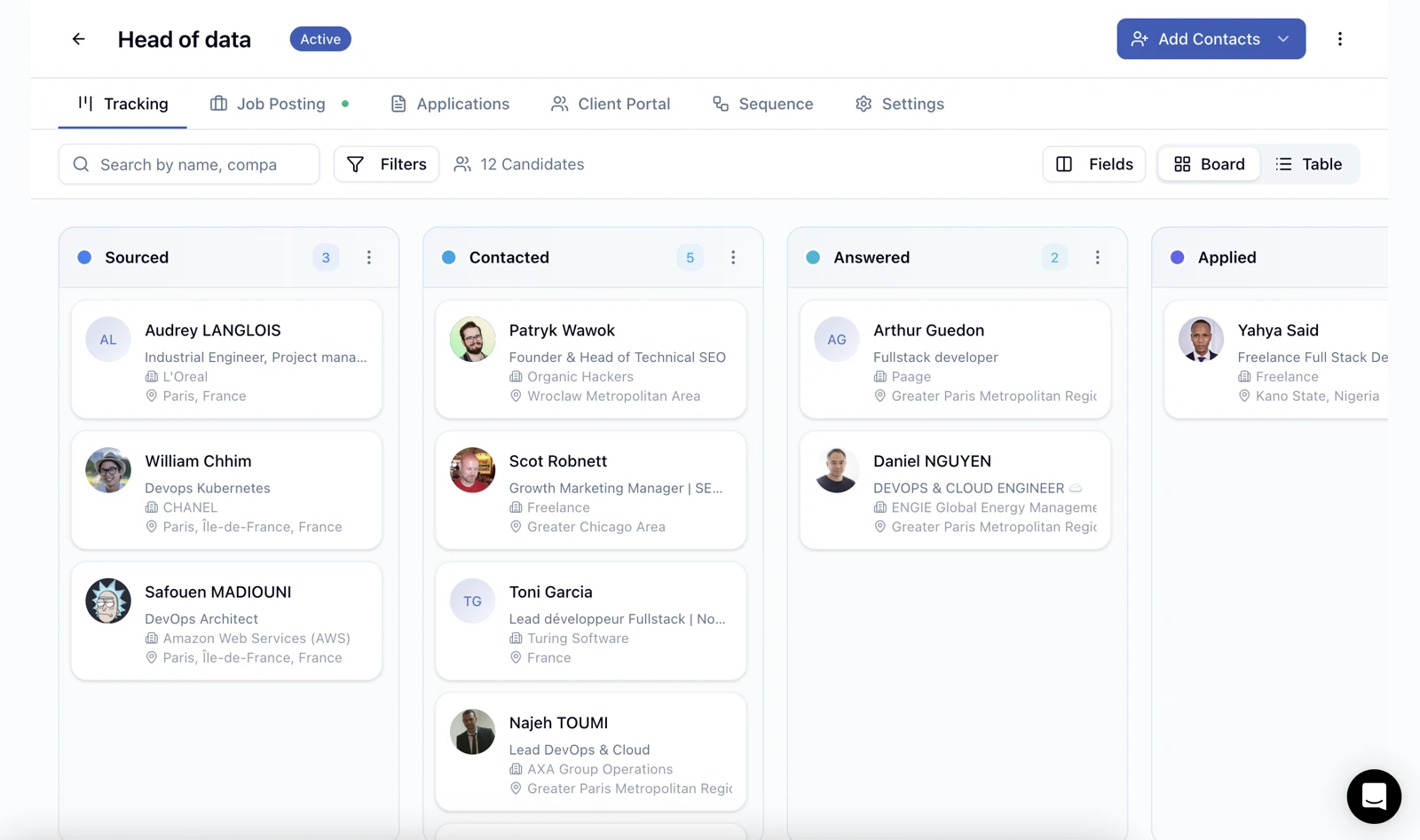
- AI-assisted architecture: review selected records, prepare tasks and update your CRM after approval rather than just generate text
- Sourcing workflow: organize selected records, review AI scoring and keep next actions visible
- Multichannel outreach with automated WhatsApp, email and SMS steps, plus LinkedIn reminders, from a unified inbox
Recruit CRM vs Bullhorn: Feature comparison
| Features | Recruit CRM | Bullhorn |
|---|---|---|
| Pricing & Transparency | ||
| Published pricing on website | ||
| Free trial available | ||
| No long-term contract required | ||
| Transparent renewal terms | ||
| All core features in base price | ||
| AI Capabilities | ||
| AI candidate matching | ||
| AI resume parsing | ||
| AI email and outreach drafting | ||
| AI sourcing agents | ||
| AI included in base tier | ||
| Customization & Workflow | ||
| Chrome extension for profile capture | ||
| Custom fields on contacts and companies | ||
| Custom pipeline stages | ||
| VMS integrations (Fieldglass, Beeline) | ||
| Pay & Bill module | ||
| Client portal for hiring managers | ||
| UX & Onboarding | ||
| Modern, intuitive interface | ||
| Self-serve onboarding (no consultant needed) | ||
| Mobile app | ||
| Average onboarding under 2 weeks | ||
| Drag-and-drop Kanban boards | ||
| Multichannel Outreach | ||
| Email sequences | ||
| LinkedIn reminders inside sequences | ||
| WhatsApp outreach | ||
| SMS outreach | ||
| Unified inbox across channels | ||
When to choose Recruit CRM, Bullhorn or Leonar
Choose Recruit CRM if...
Choose Recruit CRM if you run a small to mid-sized agency (under 50 recruiters) that places mostly direct-hire roles and wants modern UX without an implementation project. The published pricing, fast onboarding, and balanced ATS plus CRM make it a sensible default for growing firms that have outgrown a spreadsheet but do not want enterprise complexity. It is also a strong fit if your team values client-facing collaboration tools like the hiring manager portal, and if you can live without VMS or Pay & Bill workflows.
Choose Bullhorn if...
Choose Bullhorn if you run a large staffing operation that depends on temp or contract placements, needs VMS integrations like Fieldglass or Beeline, or requires Pay & Bill inside your ATS. Bullhorn is also the safer pick for enterprises that need a mature partner ecosystem, deep compliance reporting, and are willing to invest in a 3-6 month implementation. If your placement volume is high and your processes are tightly coupled to existing enterprise systems, Bullhorn remains the industry default despite the higher total cost.
Choose Leonar if...
The Recruit CRM versus Bullhorn debate usually comes down to a single trade-off: modern UX and clear pricing on one side, enterprise scale and integrations on the other. A growing number of agencies are no longer accepting that trade-off. They want both, plus AI that actually does work.
Leonar is an AI-native ATS and CRM built from the ground up for outbound recruiting teams. Pricing is published: $119/user/mo Starter and $199/user/mo Professional. The 870M+ profile sourcing database, multichannel outreach including WhatsApp, and the Chrome extension for sourcing are all included at the listed price, with no add-ons or sales calls.
Why modern agencies are choosing a third option
The Recruit CRM versus Bullhorn debate usually comes down to a single trade-off: modern UX and clear pricing on one side, enterprise scale and integrations on the other. A growing number of agencies are no longer accepting that trade-off. They want both, plus AI that actually does work.
Leonar is an AI-native ATS and CRM built from the ground up for outbound recruiting teams. Pricing is published: $119/user/mo Starter and $199/user/mo Professional. The 870M+ profile sourcing database, multichannel outreach including WhatsApp, and the Chrome extension for sourcing are all included at the listed price, with no add-ons or sales calls.
The architectural difference matters. Leonar organizes the sourcing records your team selects, runs AI scoring review on them, and keeps the next actions visible in one place. Recruit CRM has a Chrome extension but no selected-record organization. Bullhorn has only basic profile viewing. For agencies producing shortlists every week, that gap is the difference between hours and minutes per shortlist.
What sets Leonar apart
- Transparent published pricing: $119/user/mo Starter, $199/user/mo Professional, no add-ons
- AI-assisted architecture: review selected records, prepare tasks and update your CRM after approval rather than just generate text
- Sourcing workflow: organize selected records, review AI scoring and keep next actions visible
- Multichannel outreach with automated WhatsApp, email and SMS steps, plus LinkedIn reminders, from a unified inbox
- WhatsApp voice notes you can record from the desktop inbox, plus AI message variables generated per recipient at send time
- Self-serve onboarding in days, not months, with an interface designed for recruiters
The honest 30-second answer for Recruit CRM vs Bullhorn
You came here to pick one. The honest answer is that the right choice depends on three variables: how big your agency is, whether you place temp or contract workers, and how central LinkedIn Recruiter is to your sourcing. Here is the short version, before the matrix below.
Recruit CRM is the better fit if you run a small or mid-size agency, between 5 and 30 recruiters, and you want a modern interface, fast onboarding, and a published tier ladder you can read without booking a sales call. Their support team replies in under two minutes, their integrations marketplace covers most of what an agency needs, and their pricing is closer to what you would budget for a per-seat tool.
Bullhorn is the right pick if you run enterprise staffing, 50 recruiters or more, and you place temp or contract workers. Bullhorn owns VMS connectivity (Fieldglass, Beeline), Pay and Bill, and the kind of compliance reporting that large staffing firms cannot operate without. That is a real moat, and Recruit CRM does not have it.
Neither is the right pick if your goal is AI-native workflow automation, a built-in sourcing database, and one published price for everything you need. That is the third-option case, and we cover it in the sections below alongside the best ATS for recruiters in 2026 and Leonar vs Bullhorn head-to-head.
A note on this guide before we get into the matrix. Most comparison pages on the SERP are written by one of the two vendors or by an affiliate site that takes a side. We are running Leonar, which means we have an obvious dog in this fight. The honest move is to be specific about where Leonar wins, where it loses, and where the choice does not involve us at all. If you place temp workers and need VMS, we are going to tell you to pick Bullhorn. If you need a 5,000-integration marketplace today, Recruit CRM beats us on breadth. The point of the article is not to win every dimension. It is to help you make the right call for your agency.
Recruit CRM vs Bullhorn pricing in 2026: what they actually cost
Both vendors keep their higher tiers behind a quote, but Recruit CRM publishes more of its ladder than Bullhorn does. Here is what you can actually budget for in 2026.
Recruit CRM lists Pro, Business, and Enterprise on its site. Prices are localized by region and billing period, so check the live Recruit CRM pricing page before building a team budget. Add-ons and usage limits can change the final total.
Bullhorn publishes Starter at $99 and Core at $165 per user per month, but quotes Pro, Max, and its specialist modules. The realistic landed cost for a working agency stack climbs quickly from there. Bullhorn Automation, Textkernel parsing, Copilot, the SMS module, and the mobile app each carry separate fees. Most agencies we hear from end up at $150 to $200 per user per month after add-ons. A 10-recruiter agency lands somewhere between $18,000 and $24,000 per year, and that is before implementation.
Then there is the renewal trap. Bullhorn customers consistently report 15 to 20 percent year-over-year renewal increases once the initial contract ends. Recruit CRM publishes a localized tier ladder, but current prices still need checking at renewal. Implementation fees diverge sharply: Bullhorn quotes anywhere from $1,000 to $50,000 depending on agency size and customization scope. Recruit CRM advertises free implementation with a 10 to 12 day migration window run by their team.
For a three-year total cost of ownership, multiply Recruit CRM’s localized Business rate by your seat count and contract term, then add usage and renewal changes. Bullhorn lands around $70,000 to $85,000 in this rough 10-recruiter model (mid-range implementation, 15 percent renewal escalation, modest add-ons). Leonar at $119 Starter or $199 Professional per user per month USD has a three-year total around $43,000 to $72,000 depending on tier.
A note on what those numbers exclude. Implementation labor on your side (data cleanup, training, change management) costs roughly 40 to 80 hours of recruiter and ops time, regardless of vendor. Bullhorn typically lands on the higher end because of the customization layer. Recruit CRM and Leonar both ship leaner default configurations that fewer agencies need to retune. Integration costs (your job board credits, your sourcing data sources, your VOIP system) sit on top of every option here equally.
For a wider sweep of pricing structures across the category, our roundup of the best recruiting CRM systems compared in 2026 and the best Bullhorn alternatives for recruiting agencies cover the rest of the field, including how Loxo and Recruiterflow position against this pricing band.
AI features: where Recruit CRM and Bullhorn both retrofitted
This is the section where the two tools look most similar on a feature checklist and most different under the hood. Both shipped AI in the last two years. Neither was built for it.
Bullhorn Copilot is a chat layer sitting on top of a data model that was designed in 1999. It can summarize a candidate record, draft a follow-up email, suggest a job description, and answer a question about a contact. Useful, in the way a chat assistant inside any tool is useful. What it cannot do: autonomously run a sourcing search, query the database without a human prompt, trigger a sequence based on a real-time event, or update CRM fields based on what a recruiter actually did this morning. It is a UI feature bolted onto the schema, not an engine feature wired through it.
Recruit CRM’s “AI agents” are template generators. They draft candidate submission emails, format resumes to a client template, and summarize interview notes. Genuinely helpful for a recruiter on deadline. Same architectural ceiling though: the engine itself does not expose AI-native primitives. The AI generates text on demand, then a human takes it from there.
The architectural difference matters because of how much preparation the workspace can support. An AI-assisted system can suggest priorities, draft follow-ups, flag duplicates and organize a sourcing list, while the recruiter reviews each change. In Leonar, selected profiles, context, reminders and next-action tasks stay together so the consultant can move faster. Bullhorn and Recruit CRM also provide useful drafting and summary features, with the final action remaining user-controlled.
We are not claiming Bullhorn or Recruit CRM are bad tools. They are well-built engines for the workflow they were designed for: humans entering data, AI helping at the margins. The architectural call you are making is whether you want AI to assist your recruiters or whether you want AI to do the recurring work your recruiters keep forgetting. That decision is upstream of the feature checklist.
There is a second-order effect worth naming. Retrofit AI in a recruiting tool tends to produce features that look impressive in a demo and get used twice in the first month. The “summarize this candidate” button, the “draft an email” button, the “extract skills from this resume” button. Recruiters try them, find them mildly helpful, then fall back to muscle memory. AI-native architecture produces a different behavior pattern. The work happens whether or not the recruiter remembers to trigger it. Sequences fire, follow-ups schedule, duplicate checks run, CRM fields update from real activity. The recruiter does not need to remember the AI exists. That is the practical difference between AI-as-a-button and AI-as-an-engine, and it is the single most underweighted factor in 2026 ATS evaluations.
For a side-by-side on architecture rather than features, see Recruit CRM vs Leonar direct comparison.
Sourcing workflow: a gap both share
If sourcing is your primary constraint, how candidates actually reach the ATS matters more than any other feature on the matrix. Both Bullhorn and Recruit CRM are shallow here, in different ways.
Bullhorn ships basic LinkedIn profile-viewing capability. You can see the profile inside your ATS view. Beyond that viewing layer, Bullhorn leaves the sourcing work itself to whichever tools your recruiters already use: the ATS is where you manage candidates once they are in your pipeline, not where you find them.
Recruit CRM’s LinkedIn integration is a Chrome extension for individual profile capture. You browse to a profile, click the extension, and the contact lands in your Recruit CRM database. Sales Navigator support is partial. It is a profile-by-profile workflow, which is fine for a shortlist and slower once you are working at volume.
Leonar’s role here is different from either. It keeps selected profiles, sourcing context, notes, drafts, reminders and next-action tasks together in one workspace. Scoring helps prioritize a shortlist, and you decide which email, WhatsApp or SMS steps run automatically and which tasks stay prepared for your review.
Why this matters for an agency picking between Bullhorn and Recruit CRM today: if your recruiters spend hours each week re-keying candidates into the ATS, how sourcing records get organized outweighs almost every line item on a feature matrix. A tool that keeps your sourcing channels intact and gives you one organized workspace pays for itself in recruiter hours faster than any pricing tier difference.
For the deeper framing on this versus the scraping route some agencies take, see the risks of scraping and the alternatives.
Migration reality: how to switch (in either direction)
Buyer evaluations always underweight migration cost. Here is what the real timelines look like.
Recruit CRM to Bullhorn: typically 2 to 6 weeks. Bullhorn requires field mapping for custom fields, candidate stages, and pipeline definitions. Placement history detail often loses fidelity in transit (commission splits, fee structures, date stamps). Most agencies running this direction do it because they crossed a headcount threshold or won a staffing client that requires VMS connectivity.
Bullhorn to Recruit CRM: Recruit CRM markets a 10 to 12 day migration handled by their team. The numbers are real for standard records (contacts, candidates, jobs, notes). Custom automation rules and integration history do not transfer cleanly. Plan a 2 to 4 week parallel-run period before fully cutting over.
Either direction to Leonar: CSV export from your current ATS plus a review of selected profiles can cover the records most agencies care about. Custom fields can be mapped in Leonar’s workspace customization. The honest caveat applies the same way: any migration loses something. Fully customized Bullhorn workflows, deeply nested Recruit CRM automation, and one-off integrations rebuilt inside the new tool are work, not switches.
The realistic frame: budget a parallel-run period (2 weeks minimum, 6 weeks for larger agencies), accept that some custom work needs rebuilding, and pick the tool you want to run two years from now, not the one that matches your current setup most precisely.
One last migration nuance. The data you carry forward is rarely the data that mattered. Most agencies discover during migration that 30 to 50 percent of their existing CRM records are stale, duplicated, or never properly tagged. Migration is a forced cleanup. That is not a vendor problem, it is a data hygiene reality, and the tool you migrate into is the one that will determine whether the cleanup sticks.
Decision framework: 4 questions to pick the right ATS
Four questions, in order. Answer each before looking at any feature matrix.
1. How many recruiters? Under 30, Recruit CRM and Leonar are both reasonable picks, with the choice hinging on the AI question below. 30 to 100, all three are in play, with Bullhorn becoming attractive if you place contract workers or need formal compliance reporting. Over 100, Bullhorn is often necessary unless you are willing to split tooling across business units (which some firms do, with a Bullhorn install for staffing and a Leonar install for direct hire).
2. Do you place temp or contract workers? If yes, and if you need VMS integrations (Fieldglass, Beeline) or Pay and Bill, Bullhorn is the answer. Neither Recruit CRM nor Leonar handle that side of the business. This is the cleanest reason to pick Bullhorn over either alternative, and we are direct about it because it is true.
3. What is your AI delegation goal? If you want AI to assist your recruiters at the margin (drafting emails, summarizing notes, suggesting follow-ups), Bullhorn Copilot or Recruit CRM’s AI agents will do the job. If you want to delegate the recurring manual work itself (CRM hygiene, sequence triggers, sourcing list refinement, candidate re-engagement) to an AI layer that touches your database, neither vendor ships that architecture in 2026. The AI-native engine is the wedge.
4. Where does your sourcing come from? If most of your candidates come from channels outside the ATS and you spend hours per week organizing context, review how each tool supports selected profiles, notes, drafts and next actions. Both Bullhorn and Recruit CRM differ here. Leonar keeps that preparation in one workspace.
A short worked example. A 12-recruiter direct-hire agency in tech, primarily sourcing on LinkedIn Recruiter and Sales Navigator, no temp placements, owners who want recruiters to stop spending Friday afternoons on CRM data entry. Recruit CRM gets them a clean modern interface and reasonable pricing. Bullhorn is overkill on the staffing modules they will never use, and the sticker shock is real. Leonar fits the profile when the team wants selected-profile organization, shortlist scoring, drafts and reminders at a published price comparable to Recruit CRM Business.
A different worked example. A 65-recruiter staffing firm placing IT contractors on six-month assignments, with three Fortune 500 clients that route through Beeline. Bullhorn is the only correct answer here. The VMS connectivity, the Pay and Bill, the compliance reporting, and the scale of the platform are exactly what this firm needs. Recruit CRM cannot serve the VMS requirement. Leonar cannot either. We are direct about that because pretending otherwise wastes everyone’s time.
If your answers point toward AI-assisted preparation, transparent published pricing, and an organized sourcing workflow, see Leonar’s published pricing or read why agencies are switching to modern recruiting tooling built for agencies. If your answers point to VMS and enterprise staffing, Bullhorn is the right tool. If they point to mid-market all-in-one with a friendly interface, Recruit CRM is correct. The honest answer is that you have three real choices, not two.
Frequently asked questions
Is Recruit CRM or Bullhorn better for a small recruiting agency?
For agencies under 30 recruiters, Recruit CRM is usually the better fit. Bullhorn is engineered for enterprise staffing with long implementations, custom contracts, and a higher total cost. Recruit CRM lists localized Pro, Business, and Enterprise prices, fast onboarding, and a modern interface that recruiters can adopt without a consultant. The exception is if your small agency runs heavy temp or contract placements that depend on VMS systems like Fieldglass, in which case Bullhorn may still be necessary despite the overhead and slower deployment cycle.
Does Recruit CRM have AI features comparable to Bullhorn?
Both platforms offer AI as bolt-on capabilities rather than core architecture. Recruit CRM includes AI resume parsing and basic candidate matching in its main plans, with newer AI assistants for email drafting on higher tiers. Bullhorn provides AI through paid add-ons such as Bullhorn Automation, Textkernel, and Copilot, which are separate products layered on top of the core platform. Neither offers autonomous AI sourcing agents or AI-driven CRM updates today, which is why some agencies are evaluating AI-native alternatives that ship these capabilities natively in the base tier.
Can I migrate data from Bullhorn to Recruit CRM (or vice versa)?
Yes. Both platforms support data import via CSV and have API access on higher tiers, so migration is technically feasible in either direction. In practice, agencies moving from Bullhorn to Recruit CRM report a 4-8 week project covering candidate records, job orders, placements, notes, and custom fields. Migrating the other direction is rarer but follows a similar timeline. Many firms run both platforms in parallel for the first month to avoid disruption to active placements and to verify reporting accuracy before fully cutting over.
How do Recruit CRM and Bullhorn compare on getting candidate profiles into the ATS?
The two products differ mainly in how sourcing records reach the ATS. Recruit CRM provides a Chrome extension that captures individual profiles into the ATS, with partial support for Sales Navigator. Bullhorn offers basic profile viewing. Neither platform is designed to be the place where the sourcing search itself happens, so most agencies pair them with whichever sourcing tools they already run and use the ATS to manage what comes downstream.
What is the real cost of Recruit CRM vs Bullhorn per recruiter?
Recruit CRM lists Pro, Business, and Enterprise with prices localized by region and billing period. Check its live pricing page before calculating a team total. Bullhorn publishes Starter at $99 and Core at $165 per user per month but quotes its higher tiers, and agencies report add-on fees for automation, texting, and AI features that can push the real total to $200+/user/mo. The advertised starting price for either tool rarely reflects the true total cost of a fully-featured deployment.
Compare Leonar with other platforms
Recruit CRM vs Leonar: Which ATS CRM Is Right for Your Agency?
Recruit CRM offers a mature back-office with invoicing, a mobile app, and workflow automation. Leonar brings AI-powered sourcing from 870M+ profiles and multi-channel sequences with email, WhatsApp and SMS steps plus LinkedIn touchpoints in one platform. See how they compare across 9 categories.
Detailed comparisonLeonar vs Bullhorn: AI-Native Recruiting or Legacy Staffing Stack?
Bullhorn was built for manual recruiting workflows in 1999. Leonar was built for AI-native recruiting from day one. Here is the honest head-to-head on pricing, AI depth, Sourcing Workflow Connector, and the onboarding experience your team actually lives with.
Recruit CRM vs Loxo
Recruit CRM is the modern all-in-one ATS plus CRM with workflow simplicity and clear pricing. Loxo is the sourcing-first platform with an 850M+ profile database and AI sourcing agents. Both serve recruiting agencies, but they solve different problems: Recruit CRM optimizes the day-to-day workflow, while Loxo optimizes the top of the funnel. This guide breaks down where each tool wins and where each falls short.
Recruit CRM vs Recruiterflow
Recruit CRM and Recruiterflow are both modern, mid-market ATS plus CRM platforms aimed at recruiting agencies. Recruit CRM leads on simplicity, UX, and breadth of client-facing tools. Recruiterflow leads on outreach automation and sequencing depth. Picking between them is a question of where your team spends its day. This guide breaks down where each tool wins and where each falls short.
Bullhorn vs Recruiterflow
Bullhorn is the enterprise incumbent with deep VMS, Pay & Bill, and a 150+ integration marketplace. Recruiterflow is the modern mid-market sequencer with deep email and LinkedIn cadences and transparent pricing. Both serve recruiting agencies, but the trade-off is real: scale and compliance on one side, UX and outbound depth on the other. This guide breaks down where each tool wins and where each falls short.
Streamline your recruitment with AI & automation
Join 400+ recruiting teams already using Leonar to source, engage and hire faster.
7-day free trial with full access
Methodology: features verified as of the date shown. Compliance depends on the third-party contract and current provider rules.