Talent Mapping in Recruitment: A Step-by-Step Guide
Talent mapping is how recruiters chart a market before they hire. Learn the executive search workflow, the tools, and how to build your first map.


What is talent mapping in recruitment?
Talent mapping is the process of researching and charting the strong candidates in a market before you need to hire them. You learn who the best people are, where they work, and how to reach them, so that when a role opens you start from a ready shortlist instead of a blank page.
This guide is written for agency and executive search recruiters who run talent mapping as a billable deliverable for clients. The workflow below is the one search consultants use to map a market on a mandate, not the internal HR version aimed at succession planning. If you place candidates for clients, this is the practical playbook.
Talent mapping is a continuous, iterative process. It asks recruiters to be forward-thinking about a market rather than reactive to a single vacancy. The main components of talent mapping are:
- Determining Future Talent Needs: Understanding the strategic direction of the company and the types of roles and skills that will be required in the future.
- Evaluating Current Staff Viability: Assessing whether the current workforce has the potential to meet those future needs, through upskilling or reskilling if necessary.
- Identifying High Potential Candidates: Not just within the organization and the current employees but also in the broader talent market, to fill any gaps in the current workforce’s capabilities. A strong passive talent sourcing strategy is essential for discovering these high-potential candidates who are not actively job searching.
- Developing a Strategic Recruiting Plan: Creating a targeted approach for placing the best candidates in specific job roles that align with future business objective
Talent mapping vs talent pooling vs market mapping
These three terms get used as if they mean the same thing. They do not, and mixing them up leads to sloppy client conversations.
Talent mapping is the research layer. You chart a whole segment of the market: which companies hold the talent, who the strong people are, how they cluster by team and seniority. The output is a picture of the market, not a contacted list.
Market mapping is often used as a synonym for talent mapping, and in agency work the two overlap almost completely. When people draw a line, market mapping leans toward the competitive landscape (which firms employ the target talent, how teams are structured, what they pay), while talent mapping leans toward the individuals inside that landscape. On a real mandate you do both at once.
Talent pooling is what happens after the map. A talent pool is the working list of people you have engaged and want to stay in touch with. Mapping tells you who exists; pooling is the relationship you build with the ones worth nurturing. You map once per market, then keep pooling for years.
The executive search market-mapping workflow
For an agency or search firm, talent mapping is a deliverable a client pays for. The client wants to see the market before committing to a search, or wants a picture of a competitor’s bench. The workflow has four stages, and each one produces something you hand to the client.
Stage 1: Take the client brief and define the scope
Every map starts with a scope, and a vague scope produces a useless map. Sit down with the client and pin the boundaries: which roles, which seniority band, which geographies, and which companies count as in-scope. Agree on what “good” looks like, because a Head of Data at a 40-person startup is a different person from one at a bank. Write the target profile down and get the client to sign off on it before you spend a day sourcing.
Stage 2: Scope the market and build the company list
With the profile agreed, map the companies that hold the talent. Start with the obvious direct competitors, then add the adjacent firms your client may not think of: the feeder companies people move from, the firms one tier up and one tier down, and the players in neighboring sectors that grow the same skills. This company list is the backbone of the whole map. Every strong candidate you find will sit inside one of these firms.
Stage 3: Build the long-list
Now you populate the map with real people. Work company by company and pull the individuals who match the target profile, recording their current title, tenure, and where they sit in the reporting line. This is the slow part of the job, and it is where a good sourcing setup earns its keep.
The long-list is not a shortlist yet. It is the full population of qualifying candidates in the mapped market. That is exactly what makes a map valuable: it shows the client the whole field, not just the three people who answered a message.
Stage 4: Present coverage and market insight to the client
The map is only worth what you can show. Package it so the client can see the picture at a glance: how many qualifying people exist, how they split across the target companies, the salary bands you found, and the gender and background mix if diversity is part of the brief. Flag the people who are reachable now versus the ones who need nurturing.
This coverage view is the real product. It tells the client whether the search is easy or hard before a single approach goes out, and it positions your firm as the one that knows the market cold.
Talent mapping strategy for recruitment in five steps
It can be difficult to define and identify where to start when you want to implement a talent mapping strategy in your company and your recruitment processes. Here is a list of five steps describing and easy way to implement a talent mapping roadmap.
1) As-is evaluation and future needs planning
This step is foundational. It involves assessing the current state of the workforce and determining future business objectives and the corresponding talent requirements. This forward-looking analysis is crucial for identifying any gaps between the current workforce’s abilities and future needs.
Considering how your company is going to grow and operate in the future, you need to define who are the candidates you will need to hire in the next months and years. You have to be able to answer these questions:
- In what departments will I have to do hire ? When ?
- What are the positions that I will need to fill ?
- What are the positions that I will be able to fill internally ? What are the ones for which I need to hire people ?
2) Defining the targeted persona for today’s and future’s desired candidates
By creating detailed profiles for ideal candidates, both for current and future roles, organizations can better target their recruitment and development efforts. These personas can include skill sets, experience, potential for growth, and alignment with company culture and current employees.
This is what we call ICP, or Ideal Candidate Persona. In recruitment, an Ideal Candidate Persona (ICP) is a representation of the perfect candidate for a specific role within a company. It’s a detailed profile that includes the experience, skills, and traits that a company deems most important for a particular position.
When creating an ICP, a company typically considers:
- Professional Background: Past job roles, industry experience, level of expertise, and career progression.
- Skills and Competencies: Hard skills, technical knowledge, soft skills, and other competencies relevant to the job.
- Education and Certifications: Academic qualifications, professional certifications, and continuous education relevant to the role.
- Personality and Cultural Fit: Traits that would make the candidate a good fit within the company’s culture, work style, and values.
What can help you to create the ICP is the performance of the current top employees. You have to define what are the key indicators that will guarantee the performance of a future employee.
With a good sourcing tool, you can save filters for future candidate searches. For example:
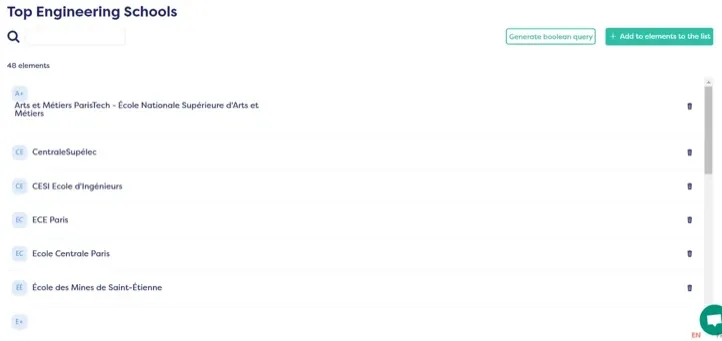
If you know that have to target each year junior coming from the best Engineering Universities, you can set a saved filter on all Engineering Schools

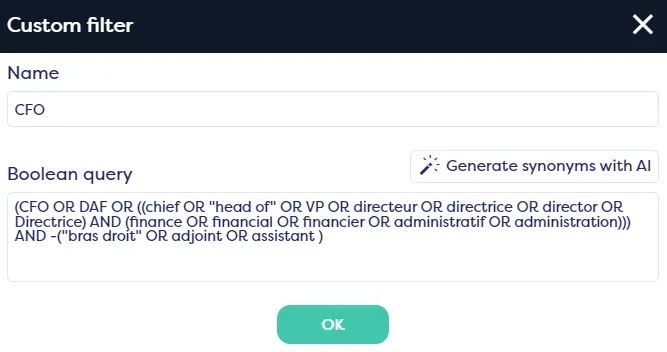
Imagine you know that you will need to hire a CFO next year. You can start building you network, knowing that these recruitment can be tough. You can save a boolean search that you will be able to use on Linkedin Recruiter or on any jobboards to find your future CFO.
This is where Talent Mapping starts, right after you separate sourcing from recruiting in your process. Using informations and data regarding the candidates you will have to target, you start building a strategy on how you are going to map the recruitment market and identify the top talents. Pairing your talent mapping with proven recruitment sourcing strategies will help you reach the best candidates in your identified segments.
3) Company and market mapping
Understanding the landscape in which the company operates, including industry trends, competitor strategies, and labor market conditions, helps identify where the company stands and where it might find the talent it needs. This mapping can reveal opportunities and threats related to talent acquisition and retention.
Regarding company, these are the questions you will have to answer:
- What are my direct and indirect competitors in recruitment?
- Where do the candidate who I aim to hire work for?
The idea is to make a list of companies that you will use to target candidates in the future. A list can be used for different job position. A job position may also require several lists of companies.
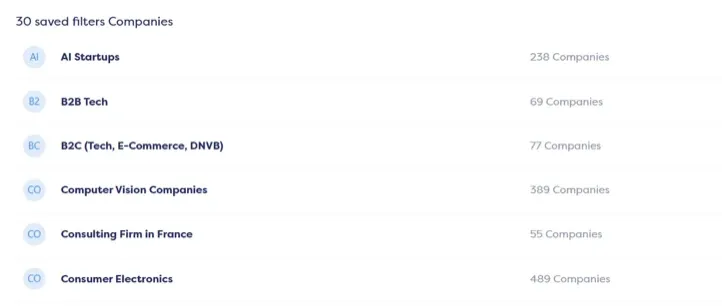
In this example above, a recruiter knowing he will have to recruit candidates with Artificial Intelligence knowledge has decided to map and identify all startups working on AI products. These companies will surely be an interesting reservoir of top AI candidates in the next months.
4) Building strong talent pools and animating a network
Developing a reservoir of potential candidates and actively engaging with them can ensure a quicker and more precise match when roles become available. This includes nurturing relationships with passive candidates and maintaining an active presence in relevant talent communities.
How to build a talent pool?
- Keep track of all the candidates you have engaged with, whether they open to new opportunities or not
- Start sourcing new potential candidates you will need to outreach in the next months
- Engage Passive Candidates: Reach out to individuals who are not actively job searching but may be interested in future opportunities.
- Add to your network all these candidates
- Add to your mailing list and newsletter list the most important candidates
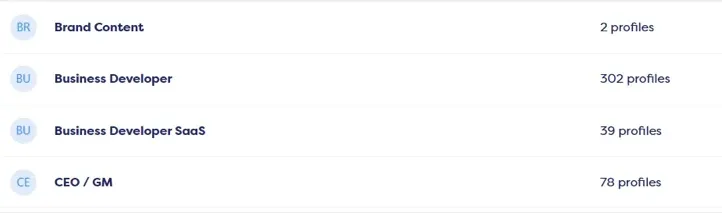
In a well-organized sourcing platform, candidates are automatically added to a talent pool. The time you spend sourcing today also supports future searches.
How to nurture relationships with candidates from a talent pool?
Candidate nurturing is the process of building and maintaining relationships with potential job candidates with the goal of keeping them engaged and interested in the company until the right job opportunity arises for them.
Good nurturing is mostly consistency. Keep in touch with personalized messages that share real news, not spam: a market update, a relevant article, an invitation to an event you are running. Engage with candidates where they already are, usually LinkedIn, and comment on their work rather than pitching a role every time.
When you do have something relevant, make the outreach specific to that person’s career path, and keep detailed records so the next touch builds on the last one. The goal is simple: when the right mandate lands, the strong people already know your name.
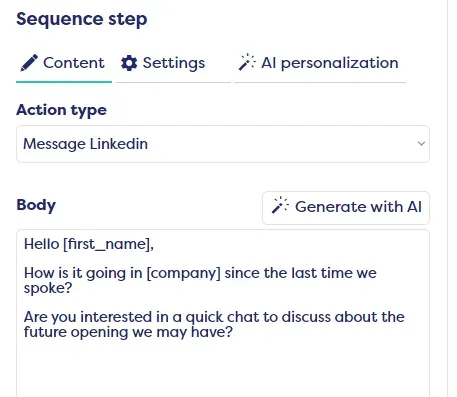
A structured recruitment platform makes this manageable at scale. It keeps track of every discussion you have had with a candidate across recruiters and channels, whether that is a LinkedIn message, an InMail, an email, or a WhatsApp message. You can set up a messaging sequence that runs across those channels to share updates over time, and personalize each message with AI so it still reads like a human wrote it.
5) Setting the right talent acquisition channels and tools
Utilizing the most effective channels and tools for talent acquisition ensures that the effort to attract and engage with potential candidates is efficient and effective. This could involve leveraging technology, such as applicant tracking systems, social media, professional networking platforms, or traditional recruitment methods, depending on where the targeted talent pools are most active.
By Talent Acquisition Channels, this is the key areas you can work on:
- Building strong relationships with universities where you want to target candidates
- Purchasing access to the relevant jobboards
- Developing your employer branding onsite and offsite, including your social media presence
- Organizing your Talent Acquisition team to meet your recruitment goals
- Contracting with the right recruitment agencies, specialized in your industry
The key tools you will probably need to implement for designing the best talent acquisition and talent mapping processes:
- An ATS (Applicant tracking system) to manage all inbound processes
- A Recruitment CRM or Automation Software to improve the sourcing and outbound recruitment processes, and be able to better work on talent mapping. A purpose-built candidate sourcing software integrates all these capabilities into a single platform
How to support your talent mapping strategy with the right tools
A good sourcing and CRM setup supports every stage of the map. You can chart the companies and educational backgrounds you want to target, save the boolean searches you reuse for each job title, build the talent pools that come out of the map, and nurture those pools over time from one place.
The slowest stage is building the long-list, and this is where AI sourcing helps most. Instead of pulling profiles company by company, you source from a large profile database using advanced filters and AI scoring and let the tool surface the qualifying people across your mapped company list.
Leonar ships a native database of more than 870 million profiles, searchable from the entry Starter plan with profile reveals paid in credits, and its AI sourcing runs on the Professional plan. See the published pricing page for the tiers. The map still needs your judgment: AI widens the field you see, but you decide who belongs on the long-list.
If you run mapping mandates for clients, the tooling choice sits alongside your case management. Our guide to the best ATS for executive search firms breaks down the platforms that pair market mapping with client and off-limits tracking, and the Leonar for executive search page shows how the sourcing and CRM pieces fit together for a boutique firm.
Why talent mapping gives recruiters an edge
Talent mapping is a strategic process that is essential for organizations looking to align their workforce capabilities with their long-term business goals. By effectively mapping talent, organizations can ensure they have the right people with the right skills in the right positions at the right time, which is crucial for maintaining a competitive edge and achieving long-term success. To measure the effectiveness of your talent mapping efforts, tracking the right strategic sourcing KPIs is essential.
Who should implement a talent mapping strategy in recruiting processes?
Talent mapping strategy in companies
The implementation of a talent mapping strategy in recruiting processes typically involves multiple stakeholders within an organization, each playing a critical role:
- Human Resources (HR) Leaders: They are often at the forefront of developing and overseeing talent mapping strategies. HR leaders work to align the strategy with the organization’s broader human capital and business objectives.
- Talent Acquisition Team: Recruiters and talent acquisition specialists execute the day-to-day aspects of talent mapping, such as identifying, attracting, and engaging with potential candidates. They apply the strategy to fill current vacancies and build pipelines for future needs.
- Senior Executives and Department Heads: Executives and managers define the strategic direction of the organization, which shapes the talent mapping strategy. Their insight into future business needs is vital for understanding what skills and roles will be required.
Talent mapping strategy in recruitment agencies
For recruitment agencies, talent mapping is both a service you sell and a strategic advantage you keep. The process differs from the in-house version because you serve several clients at once, each in a different sector. The agencies that do it well share a few habits.
They know their clients’ industries cold, including the market trends, the competitive landscape, and the specific talent each sector fights over. They invest in client relationships so each map reflects that client’s real strategy and culture, not a generic template. They profile candidates on aspiration and growth potential, not just the current title, so the same person can fit a client’s future role as well as today’s vacancy.
They also build diverse talent pools of active and passive people and keep those relationships warm across mandates. And they treat market intelligence (talent availability, salary benchmarks, hiring difficulty) as a product in its own right, one that positions the agency as an advisor rather than a vacancy-filler. Good tooling, an ATS, a recruitment CRM, and data, is what makes all of this repeatable instead of heroic.
How to make talent mapping a recurring habit
Talent mapping works best when it is not treated as a one-off project. Review your personas, company lists, and talent pools every quarter so your team keeps a fresh view of the market.
Answer 3 quick questions and we will recommend the best option for your hiring workflow.
How large is your recruiting team?

Author
André FarahCo-founder
André Farah is co-founder of Leonar, where he leads product strategy for the recruiting platform. With over 8 years of experience in HR technology and recruitment process optimization, he specializes in designing sourcing workflows, outbound sequences, and candidate engagement systems. André works closely with staffing agencies and in-house talent teams to build repeatable hiring processes that scale. He regularly shares insights on Boolean search techniques, multi-channel outreach, and the operational side of modern recruiting.