Retained vs Contingency Recruitment: Which Wins?
Retained vs contingency recruitment compared: fees, exclusivity, speed, and a clear decision framework for which engagement model fits your next hire.


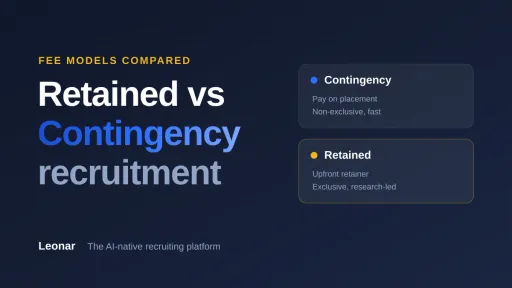
Contingency recruitment pays the agency when you hire and is often non-exclusive. Retained search charges during the process and is usually exclusive. The first structure can put more weight on speed. The second funds an agreed research process from the start.
Those structural differences shape payment timing, exclusivity, research scope, and financial commitment. They do not guarantee a hiring outcome. This guide compares both models side by side, adds the hybrid container option, and gives you a framework for choosing. It serves two readers at once: the company deciding how to engage, and the agency deciding which model to sell.
Retained vs contingency recruitment at a glance
Before the detail, here is the whole comparison in one view. Read down the column that matches your situation, then use the sections below to pressure-test your choice.
This table answers the headline question for most readers. The rest of the guide explains why each row looks the way it does, and helps you decide when the trade-offs are worth it. For the exact fee percentages behind these models, our breakdown of how much recruitment agencies charge has the real numbers by role type.
How contingency recruitment actually works
Contingency is the model most people picture when they think of a recruitment agency. You brief one or more firms on a role. They send candidates. You pay a fee only if you hire someone they introduced. If nobody works out, you pay nothing.
The appeal is obvious. There is no upfront cost and no risk on paper. You can brief three agencies at once and let them compete. Whoever delivers the winning candidate first gets paid, and the rest walk away with nothing.
When several firms work the same role, the placement-linked fee can make speed a stronger incentive. A contingency recruiter may prioritize candidates who are already applying and easy to reach. That does not prevent targeted outreach or deeper research, but the agency must decide how much unpaid time it can commit before another firm fills the role.
For the right role, none of that matters. If you are hiring a mid-level position with a healthy talent pool, active candidates are often exactly who you want, and speed is a feature. Contingency shines for well-defined roles where good candidates are plentiful and the cost of a slower, deeper search would be wasted.
The trade-off becomes clearer on senior or scarce roles. Without an exclusive commitment, a firm may be less willing to fund weeks of talent mapping for a fee it might never earn. Some contingency firms still offer that depth, especially when the brief or relationship justifies it. Retained terms make the research commitment explicit from the start.
How retained search actually works
Retained search flips the incentive. You pay a firm upfront to run an exclusive search, and that fee is owed whether the role fills in three weeks or three months. In exchange, one consultant owns the mandate end to end and commits real research time to it.
The fee is usually split into installments. A common structure bills one third when you engage the firm, one third when they deliver a qualified shortlist, and one third on placement. The exact split varies, but the principle holds: you are paying for a process, not just a result.
Because the firm is funded during the process, it can reserve time for market mapping, direct outreach, and structured assessment against the brief. Running that research at senior level is easier when your systems support it, which is why the executive search software features that keep a mandate organized matter as much as the fee model. These methods are not unique to retained search. The difference is that a retained contract usually defines and pays for them from the start.
Retained agreements often make confidentiality an explicit part of the intake brief. When you replace a sitting executive or enter a new market quietly, the firm can use controlled outreach instead of a public advert. A contingency firm can do the same when confidentiality is agreed. Clear ownership and communication controls help avoid the rushed or leaky processes covered in our guide to why executive searches fail.
Most retained agreements include a guarantee. If the placed candidate leaves within an agreed window, the firm runs a replacement search, often at no extra fee. Guarantee lengths run longer for senior roles, which reflects how much a leadership mis-hire can cost.
The container model: the hybrid middle ground
Not every important hire justifies a full retainer, and not every hard role suits a scramble of competing firms. The container model, also called engaged search, sits between the two and borrows the best of each.
Here is how it works. You pay part of the fee upfront, then usually pay the balance when the candidate is placed. The upfront amount may be fixed or calculated as a share of the total. Some firms credit it toward the final fee and others use different terms. The search may be exclusive, near-exclusive, or protected for a limited period, so the contract should spell out both payment and exclusivity.
That partial commitment changes the recruiter’s math by funding some work before placement. The bulk of the fee may still depend on a hire. How much research time and priority you receive depends on the agreed scope, not the model name alone.
Container search fits important roles that are not quite C-suite, and it is a common way to test a new firm. If you like an agency but are not ready to hand over a full retainer, a container arrangement lets both sides prove the relationship on real work before committing further.
The economics: what each model really costs you
The headline fee is only part of the cost. What separates these models financially is the shape of the spend, when the cash goes out, and how much risk you carry if the hire goes wrong.
Read the table as a risk map, not a price list. Contingency moves all the financial risk onto the agency, which is why the agency protects itself by chasing quick, likely placements. Retained moves risk onto you upfront, and you buy it back through exclusivity, research depth, and a guarantee. Container splits the difference.
There is a second cost that never shows on an invoice: the cost of the wrong hire, or of no hire at all. A cheap contingency search that fills a critical seat with a weak candidate can cost far more than a retainer once you count lost momentum and a repeat search. Weigh the fee against the price of getting it wrong, not just against the fee of the other model. Our full breakdown of how much recruitment agencies charge covers the exact percentage bands and negotiation levers.
A decision framework: which model fits this hire
Fee models are not good or bad in the abstract. They are a match, or a mismatch, for a specific role. Run any open hire through these five questions and the answer usually becomes clear.
Start with seniority and impact. The more senior the role and the more a mistake would hurt, the more a retained or container search pays for itself. A junior or mid-level role with clear requirements rarely needs that firepower.
Look at the talent pool next. If many qualified people are actively looking, a placement-linked search may move quickly. If the relevant pool is small and mostly passive, ask each firm how much market mapping and direct outreach it will commit. Exclusivity can support that investment, but it is not the only way to run a targeted search.
Weigh confidentiality. A search you cannot advertise, such as replacing a current leader or entering a new market, needs controlled outreach and clear information rules. Either fee model can support discretion. Retained agreements often make those controls and ownership explicit.
Factor in your hiring volume. If you hire the same kind of role several times a year, repeat contingency fees add up fast, and building internal capability starts to look cheaper. A one-off senior hire is the opposite case, where paying for outside expertise once makes sense. Agencies running those high-volume desks lean on dedicated applicant tracking software for staffing agencies to keep many live job orders from colliding.
Finally, judge your internal capability. If you have a recruiter who can run a real search, you may only need help on the hardest roles. If you have nobody to own the process, an agency is buying you both the work and the expertise.
As a rule of thumb: contingency for well-defined roles hired at volume, retained for senior or confidential roles where getting it wrong is expensive, and container for important roles in between, or when you want to test a new firm.
For agencies: moving upmarket from contingency to retained
Most of the guidance online speaks to the company doing the hiring. The other side of the table matters too. For agency owners, the shift from contingency to retained work is one of the biggest levers on profit, and it is mostly a question of capability, not ambition.
Retained clients pay during the search and usually commit exclusively. That gives the agency more predictable funding for an agreed process. Contingency revenue depends on completed placements, so recovering well after a declined offer matters even more, and firms may manage a broader portfolio of roles. Agencies can succeed under either model; moving upmarket depends on proving the research, assessment, reporting, and service level promised in the contract.
Earning retained work means showing a client that you can consistently map a market, reach passive candidates, run a structured assessment, and report on progress like a partner. Contingency firms can offer the same methods, but a retained mandate funds and defines them upfront. That research effort can consume a lean team’s week, so firms moving upmarket need to free consultants from manual sourcing and admin.
This is where modern tooling changes the math. A well-designed workspace can reduce manual profile organization, CRM entry and follow-up planning that quietly buries a small team. UK firms making that shift can compare recruitment CRM systems for UK agencies before choosing the workspace that will support it. Leonar helps recruitment agencies keep selected profiles, available context, shortlist scoring, drafts, reminders and user tasks together. Consultants still review the evidence, choose the channel and complete LinkedIn actions manually, while email, WhatsApp and SMS workflows can be managed separately. When the research is clear and the pipeline is clean, a contingency team can start taking on the exclusive mandates that used to feel out of reach. Winning those clients is a business-development skill in itself, and our guide to winning more clients for your recruiting agency covers the outreach side.
The fourth option: hiring in-house with AI sourcing
Companies that hire the same roles repeatedly have a third path that the agency debate often skips. Instead of paying a per-hire fee again and again, you build the capability in-house and use software to do the heavy lifting.
The break-even point depends on your numbers. Estimate annual agency spend as expected hires multiplied by average salary and the agency fee rate. Then compare it with the loaded annual cost of an internal recruiter, sourcing software, and any ramp-up or management cost. Building in-house is cheaper only when the first total is higher and the recruiter has capacity to deliver those hires.
Here is the trade-off: you still need someone to run it. AI-assisted sourcing tools can help organize and score selected profiles, but a person has to own the brief, screen replies, approve drafts, and close the hire. If you have that person, tools like Leonar for executive search teams can reduce repeat agency work with a searchable database, workspace context and scoring against your role. If you do not have that person, and you only hire once or twice a year, an agency is still the right call.
This is not an argument against agencies. It is a reminder that the choice is not only retained versus contingency. For repeat, well-defined hiring, in-house plus AI sourcing is a real fourth option, and it belongs in the comparison.
Which recruitment model should you choose?
The honest answer is that it depends on the role in front of you, and now you have the tools to decide. Contingency wins on well-defined roles with deep talent pools where speed matters and you would rather pay only on success. Retained wins on senior, confidential, or scarce roles where a mis-hire is expensive and you need one firm fully committed. Container splits the difference for the important roles in between.
Match the model to how much a mistake would cost, not to which fee looks smaller today. A retainer that lands the right leader is cheaper than a contingency search that fills the seat with the wrong one. And if you hire the same roles often, weigh building the capability in-house against paying the fee on repeat.
If you run an agency, the same map points the other way. The path to higher, steadier revenue runs through retained work, and retained work runs through delivery you can prove. Give your consultants back the hours they lose to manual sourcing and admin, and see how Leonar supports executive search teams and agencies moving upmarket. Whichever side of the table you are on, the right model is the one that fits the hire.
Frequently asked questions
What is the difference between retained and contingency recruitment?
Contingency recruitment pays the agency only when you hire one of its candidates, and the search is often non-exclusive. Retained search charges a fee upfront and is usually exclusive. Those structures tend to change how a firm allocates time and research, but either model can include targeted outreach and confidential handling when the contract requires it. Contingency often fits well-defined roles with a large talent pool. Retained often fits senior or hard-to-fill roles that justify a dedicated research process. Payment timing, scope, and agreed commitment are the main differences.
When should you use retained search instead of contingency?
Consider retained search when the role is senior or hard to fill, the talent pool is small, and you want to fund a defined research process from the start. A retained agreement usually reserves dedicated consultant time and may include market mapping, milestones, and confidential handling. Contingency can make more sense for well-defined roles with many available candidates when you prefer to pay only after a hire. It can still support targeted or confidential work if those requirements are agreed. Compare the process, resources, and contract terms, not an assumed difference in candidate quality.
How much does retained search cost compared to contingency?
Both models are typically priced as a percentage of the candidate's first-year salary, but the payment structure differs. Retained fees are usually split into installments, often billed across engagement, shortlist, and placement, and you pay them whether or not the search finishes quickly. Contingency fees are paid in one lump sum when you hire. Retained often sits at the higher end of the range and usually includes an upfront commitment. Exact percentages, scope, and exclusivity vary by firm and contract. See our guide on how much recruitment agencies charge for detailed fee bands.
What is the container or engaged search model?
The container model, sometimes called engaged search, is a hybrid of retained and contingency. You pay part of the fee upfront, then usually pay the balance when the candidate is placed. The upfront commitment may be a fixed amount or a share of the total, and whether it is credited varies. Exclusivity can be full, near-exclusive, or limited for an agreed period. The exact amount, research scope, and exclusivity terms depend on the firm and contract, so confirm them in writing.
Can you switch from contingency to retained search mid-hire?
Yes. If a contingency search stalls because the role is harder than expected, the client and agency can renegotiate to a retained or container arrangement. The agency receives an upfront commitment and agrees a new research scope. Exclusivity may be full, partial, or time-limited, depending on the contract. This usually works best early, before several firms have approached the same candidates. Agree the new fee, research deliverables, exclusivity terms, and any credit for work already done in writing.
Which recruitment model is better for startups or first-time hirers?
It depends on the role, not the company size. A startup filling a first VP or founding engineer should lean retained or container, because that hire shapes the company and the talent pool is thin. The same startup filling a fifth support rep can use contingency or even hire in-house, because the role is well-defined and candidates are plentiful. First-time hirers often default to contingency because paying only on success feels safer, but that logic breaks down for critical roles where the real risk is hiring the wrong person, not paying a fee. Match the model to how much a mistake would hurt.
Answer 3 quick questions and we will recommend the best option for your hiring workflow.
How large is your recruiting team?

Author
Pierre-Alexis ArdonCo-founder
Pierre-Alexis Ardon is co-founder of Leonar, where he focuses on building AI-powered recruiting systems, assisted sourcing, and search optimization. With a background in engineering and over 7 years working at the intersection of artificial intelligence and talent acquisition, he designs the algorithms that power Leonar's candidate matching and workflow assistance. Pierre-Alexis advises recruitment agencies on their digital transformation and regularly publishes analyses on how AI agents are reshaping HR workflows. He is passionate about making advanced technology accessible to recruiters who are not engineers.