Top 5 Juicebox alternatives for sourcing candidates
The best Juicebox alternatives in 2026 are Leonar, Pin, HireEZ and SeekOut. Compare pricing, AI sourcing and multichannel outreach for recruiters.


The best Juicebox alternatives in 2026 are Leonar for multichannel outreach, Pin for end-to-end automation, HireEZ for enterprise ATS integration, and SeekOut for technical sourcing. Each one closes a gap in Juicebox’s search-first design, from broader outreach channels to contact-data accuracy. Juicebox automates email while keeping LinkedIn touchpoints as manual sequence tasks.
Below we review five tools recruiters actually switch to, with pricing verified in August 2026, a clear answer to the Chrome-extension question, and guidance on which head-to-head comparison to read if you have already shortlisted Juicebox against one rival. If you want the short version: pick the alternative that fixes your biggest bottleneck, not the one with the longest feature list.
What Juicebox is and what PeopleGPT actually does
Juicebox (formerly PeopleGPT) is an AI-powered talent sourcing platform built to work like a “search engine for people.” It moves past keyword-based recruiting by using generative AI to read natural language. Instead of clunky Boolean strings, a recruiter can simply ask for what they want.
For example, a recruiter can type: “Find me software engineers in San Francisco with 5+ years of Python experience who have worked at a top AI lab and published research.” Juicebox turns that plain-English brief into a candidate list drawn from a database of roughly 800 million profiles.
Recruiters reach for a tool like Juicebox for two main reasons. The first is speed, because AI-powered search surfaces candidates faster than manual filters. The second is cost control, since teams want to stop leaning only on expensive LinkedIn premium seats.
That second point matters. LinkedIn keeps getting more expensive, and one LinkedIn Recruiter Corporate account can cost more than $6,000 a year per licence. For an agency or a large talent acquisition team, that is a heavy line item. If licence cost is your driver, our roundup of LinkedIn Recruiter alternatives covers cheaper ways to source at scale.
Where Juicebox falls short for outbound recruiting teams
While Juicebox is a powerful sourcing engine, its search-first focus creates several practical limits. A primary concern is the size and freshness of its database. Although it aggregates over 800 million profiles, its reliance on publicly aggregated web data means recruiters often encounter outdated information, leading to wasted time on inaccurate profiles.
This data quality issue also impacts the quality of the filters; while the natural language search is innovative, its effectiveness can be inconsistent, especially for niche or non-technical roles where the AI may not fully grasp the required context, and returns irrelevant candidates.
Furthermore, the platform’s utility narrows significantly after the search phase. Its outreach features are almost exclusively limited to email. For modern recruiters who depend on a multi-channel engagement strategy, this is a major drawback. This “search-first” focus also creates issues with its limited integration into an ATS.
While Juicebox can connect to many Applicant Tracking Systems, it is not a full-featured platform. The workflow often requires recruiters to manually export lists rather than managing candidates in one seamless pipeline, forcing teams to patch together multiple different tools.
There is also a browser-extension question that trips up new users. Numerous recruiters on forums like Reddit report LinkedIn account warnings or suspensions after heavy use of browser sourcing extensions, Juicebox included. We answer the Chrome-extension question in full further down, since it is one of the most searched things about the tool.
The 5 best Juicebox alternatives at a glance
| Software | Best For / Key Focus | Key Features | Key Limitations |
|---|---|---|---|
| Leonar | Teams needing multi-channel outreach and AI search that understands context. |
| Newer to the market; requires trusting the AI's contextual interpretation. |
| Pin.com | Recruiters who want a fully automated "assistant" for sourcing, outreach, and scheduling. |
|
|
| HireEZ | Enterprise companies needing a high-power, fully integrated platform. |
|
|
| Seekout | Recruiters focused on Tech & Engineering roles. |
|
|
| HeroHunt | Teams who want a "set it and forget it" autonomous AI sourcer. |
|
|
For more alternatives, check our blog post on the best talent sourcing platforms.
The 5 best Juicebox alternatives for AI sourcing, reviewed
Leonar

Many sourcing tools today talk about “AI.” In reality, most just use AI to create a big Boolean query for the user. Leonar aims to go further. Its AI is designed to analyze and sort profiles using criteria that cannot be put in a simple filter.
For example, the AI can understand a request for “4 years of experience specifically in a python developer role,” not just 4 years at a company with “Python” as a keyword. It can also identify a candidate “working currently in a SaaS B2B company,” a detail standard filters miss.
Where Leonar truly shines is its multichannel outreach. It surfaces available contact information, like emails and phone numbers, and builds sequences with automated email and WhatsApp steps, LinkedIn touchpoints as manual tasks, and WhatsApp voice notes recorded from your desktop. That covers more channels in one place than Juicebox’s email-first sequences.
Leonar’s AI talent sourcing capabilities go beyond simple keyword matching to review selected records and explain the context behind each match. This makes it a strong tool for both in-house and agency teams, cutting review time and keeping next actions visible.
On pricing, Leonar is transparent where several rivals are not. As of August 2026, the published price is $119/user/mo on the Starter plan and $199/user/mo on Professional, or $169/user/mo on a 12-month commitment billed monthly, with a 7-day trial and 50 credits to explore the data layer. Multichannel sequences with automated email and WhatsApp steps (LinkedIn touchpoints as manual tasks), AI sourcing and WhatsApp voice notes all sit on the Professional plan. You can see the full breakdown on the Leonar pricing page.
Pin.com
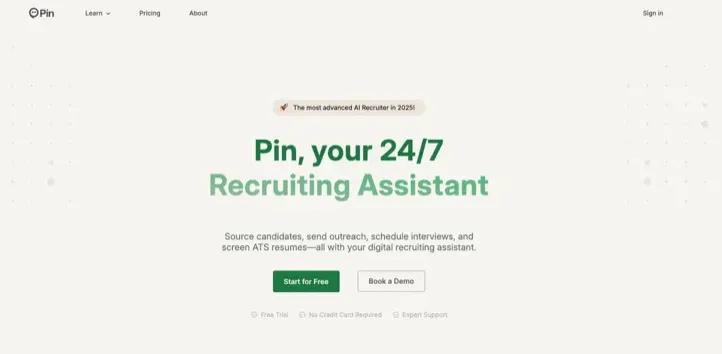
Pin is another highly innovative player in the AI recruiting space. It markets itself as an end-to-end “AI recruiting assistant” designed to automate the most time-consuming parts of the job, including sourcing, outreach, and scheduling. Its core feature is an advanced AI search that, much like Juicebox, understands natural language and learns from your feedback to refine its results.
However, this automation-first approach comes with a significant trade-off. The platform heavily relies on its AI to interpret your needs, which means users have low control over traditional, granular filters. For many, this is a benefit, as it removes the need for complex search strings.
This design makes it less adapted for advanced recruiters and sourcers. Sourcing experts who have spent years mastering Boolean logic and specific search tactics may find Pin’s “black box” approach frustrating. When searching for highly niche or technical roles, they may find the AI’s results are less precise than what they can achieve with their own manual, targeted searches.
Pin is one of the more affordable options to test. As of August 2026, it offers a permanent free plan, a Solo tier at $99/mo, and a Professional tier at $135/user/mo billed annually, with Business pricing on a custom quote. That free plan makes it easy to trial the automated-assistant approach before committing.
HireEZ
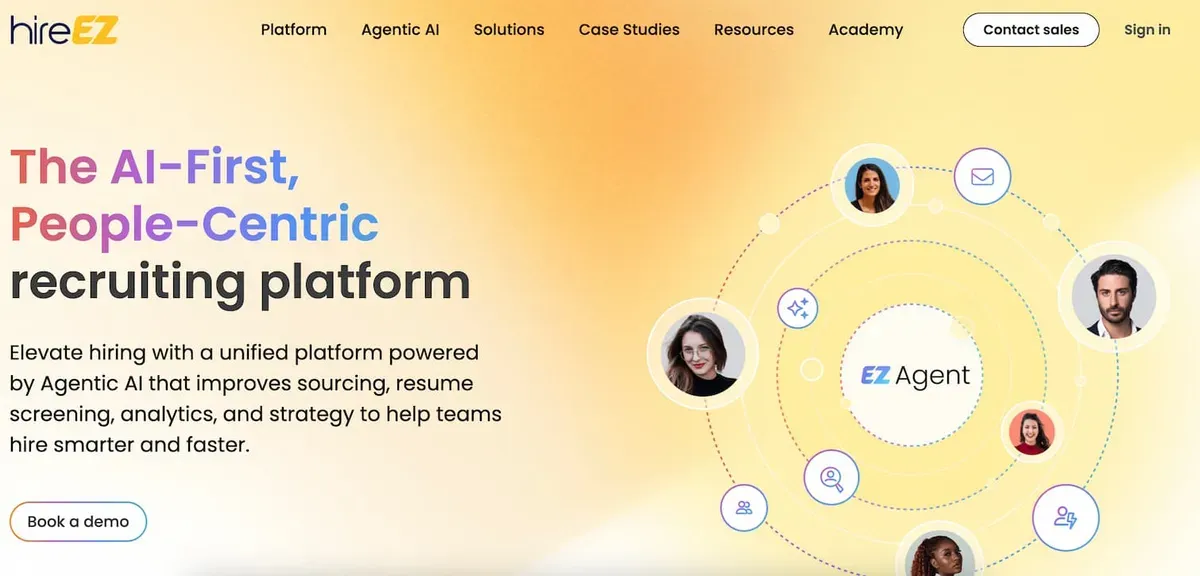
HireEZ is a heavy-duty alternative to Juicebox. It is a complete outbound recruiting platform, not just a search tool.
Its core strength is integration. HireEZ connects seamlessly with dozens of top Applicant Tracking Systems (ATS), including Greenhouse, Workday, and Lever. This allows teams to sync all sourcing, outreach, and candidate data directly into their main workflow, eliminating manual data entry.
This powerful, all-in-one system comes at a high cost. As of August 2026, HireEZ publishes a Solo plan at $494/mo with a 7-day trial, but it does not post full pricing: team and enterprise plans are quote-based and scoped against the stack they replace.
User reports and marketplace data confirm it is one of the most expensive tools in the category, making it a premium solution for teams with a large budget rather than a small agency or a solo recruiter.
Seekout
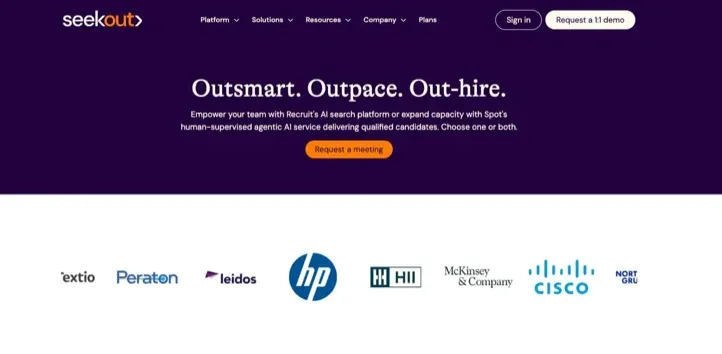
Seekout is a well-known sourcing platform, historically famous for its focus on tech candidates.
The main advantage of Seekout is its powerful aggregation. It combines GitHub profiles with LinkedIn profiles, giving recruiters a much clearer picture of a technical candidate’s real skills. This is perfect for identifying strong developers who may not list all their project details or programming languages on LinkedIn.
The downside is that Seekout is not a dedicated messaging platform. While it finds contact information, its outreach features are less robust. Messages can get lost, and as many users on Reddit report, the phone numbers and emails it finds are rarely correct. This can lead to high bounce rates and wasted time on dead-end contact info.
Seekout publishes a self-serve entry price. As of August 2026, SeekOut Recruit Core starts at $149/mo paid annually or $179/mo billed monthly. Team and enterprise plans are custom-priced, so larger buyers need a quote.
If accurate contact data is a priority for your team, our guide to the best email finders for recruiters compares the most reliable tools on the market.
HeroHunt

Herohunt positions itself as a fully autonomous AI recruiter, particularly through its “Uwi” agent. It aims to automate the entire top-of-funnel process. Users provide a job description, and the AI autonomously searches its database (including LinkedIn and GitHub), screens and ranks candidates, finds contact information, and even launches personalized outreach campaigns.
This makes it a true “set it and forget it” tool, which is highly innovative. However, user reviews suggest this automation can be a major drawback. Some users on G2 and Reddit report significant issues with the quality of the contact data, leading to high email bounce rates that can damage a company’s sending reputation.
Others note that the AI screening, while fast, can miss nuances, ranking junior candidates for senior roles. This lack of human oversight makes it a risky choice for complex or high-stakes searches. HeroHunt does not publish a clear per-seat price on a standard plan, so budget it as a quote-based tool and confirm the current cost with their team before you commit.
Does Juicebox have a Chrome extension, and what does it do?
Yes, Juicebox has a Chrome extension, and it brings PeopleGPT into your browser so you can work directly on a LinkedIn profile. In short, it reveals verified emails and phone numbers on a profile without switching tabs, scores how well that person fits an open role, and lets you add them to a Juicebox email sequence. It also tracks outreach you send from Gmail or Outlook. In short, it is a convenience layer on top of the main search product, not a separate tool.
What the extension does not do is just as important. Juicebox automates email outreach and lets recruiters add LinkedIn connection requests or profile engagement to a sequence as manual tasks, with a prepared message and a reminder to act. It does not remove the underlying risk that comes with any browser tool that acts on LinkedIn. Recruiters should read LinkedIn’s terms and use any extension conservatively, since heavy automated activity from a browser can trigger account limits.
This is where the alternatives differ at the extension layer. Leonar ships a Chrome extension too, built on Manifest V3 with a side-panel design, and it is included on every plan. Its focus is creating a CRM record from the details you confirm, where the record is enriched from Leonar’s own database and ready for a multichannel sequence, rather than stopping at a one-off email.
If browser-based sourcing is central to how your team works, weigh what each extension actually adds once the profile is in your pipeline, not just what it reveals on the page.
Juicebox head-to-head: which comparison should you read?
If you have already narrowed your shortlist to Juicebox against one specific rival, a focused comparison will serve you better than this roundup. We keep two neutral, in-depth pages for the two match-ups recruiters ask about most.
Read Juicebox vs Pin if your real choice is between hands-on AI search and a fully automated recruiting assistant. That page breaks down pricing, sourcing control, and multichannel outreach side by side.
Read HireEZ vs Juicebox if you are weighing an enterprise sourcing workbench against an affordable, transparent search tool, with a clear look at integrations, outreach channels, and total cost. Both pages show where Leonar fits as a third option, so you can compare all three before you book a demo.
How to choose a Juicebox alternative for your recruiting workflow
Before comparing feature lists, start with the bottleneck in your process. If your team finds enough candidates but struggles to reach them, prioritize outreach channels, deliverability, and contact data quality. If your team spends too much time writing Boolean searches, prioritize AI matching and natural language search.
For small recruiting teams, the best choice is usually the tool that removes the most manual work without adding a heavy setup process. For larger teams, ATS sync, reporting, permissions, and compliance may matter more than search speed alone.
Which Juicebox alternative should your team choose?
Juicebox is a powerful natural language search engine, but it’s not a complete recruiting platform. Its email automation relies on recruiters to complete LinkedIn sequence tasks manually, and it does not add WhatsApp. Uneven data freshness and the reported risk of LinkedIn account limits from browser-based sourcing are also drawbacks for outbound teams.
Choosing the right alternative isn’t about finding the “best AI.” It’s about matching a tool to your specific bottleneck. For a broader overview of what’s available, our comparison of candidate sourcing software covers the full spectrum of tools from AI-powered platforms to traditional databases.
Here is a simple breakdown:
- For Multichannel Outreach: If you need more channels than Juicebox’s email sending and manual LinkedIn tasks, Leonar is the clear choice. Its Professional plan sequences combine automated email and WhatsApp steps with LinkedIn touchpoints as manual tasks, plus WhatsApp voice notes recorded from your desktop.
- For ATS integration at large-team scale: If your priority is a tool that syncs perfectly with your ATS (like Greenhouse or Workday), HireEZ is built for this. It is a premium, high-cost solution for large teams.
- For Specialized Tech Sourcing: If you primarily recruit developers, Seekout is a strong contender. Its key feature is merging LinkedIn profiles with GitHub data, giving you a real view of a candidate’s technical skills.
- For Advanced AI Filtering: If you’re tired of Boolean logic and want AI that truly understands context (like “4 years specifically as a Python developer,” not just “Python” as a keyword), Leonar is designed for these advanced, non-boolean filters.
👉 Looking for more AI recruiting tools? Check our guide to the best AI recruiting tools.
Save time on every follow-up
Keep multichannel outreach in one sequence, see who to contact next, and move through follow-ups faster.
Answer 3 quick questions and we will recommend the best option for your hiring workflow.
How large is your recruiting team?

Author
André FarahCo-founder
André Farah is co-founder of Leonar, where he leads product strategy for the recruiting platform. With over 8 years of experience in HR technology and recruitment process optimization, he specializes in designing sourcing workflows, outbound sequences, and candidate engagement systems. André works closely with staffing agencies and in-house talent teams to build repeatable hiring processes that scale. He regularly shares insights on Boolean search techniques, multi-channel outreach, and the operational side of modern recruiting.