Bullhorn Reviews: What Staffing Teams Say in 2026
We analyzed 3,000+ Bullhorn ratings and Reddit discussions to explain its strengths, recurring complaints, pricing and best-fit teams.


Bullhorn is a solid staffing platform with polarized user feedback. Verified marketplaces show broad satisfaction with its ATS, client records and integrations. Reddit discussions focus more on speed, implementation, support, search and the cost of a full Bullhorn stack.
Both views can be accurate. A well-configured Core account used by an experienced staffing team is not the same product experience as a new agency buying Pro, Analytics, Automation and Back Office at once. We reviewed more than 3,000 ratings, recent community discussions, Bullhorn’s current documentation, and detailed pages from Atlas and Jarvi to explain the difference.
Bullhorn reviews at a glance: the short answer
Bullhorn is rated 4.2 out of 5 from 1,223 G2 reviews. Capterra shows 4.0 out of 5 from 1,023 reviews, with 4.1 for ease of use and 4.0 for customer service. GetApp France also shows 4.0 from 1,019 reviews, while Gartner Peer Insights reports 4.0 from 127 ratings.
Those numbers do not describe a failing product. On G2, 59% of reviewers awarded five stars and 31% awarded four. The strongest themes are candidate and client tracking, staffing-specific workflows, integrations, customization and a centralized history.
The complaints are still important. Capterra’s current review analysis says performance and speed are negative in 80% of 55 reviews assigned to that theme. Login and timeout feedback is negative in 85% of 33 related reviews. Other recurring concerns include extra clicks, parsing, advanced support and the cost of add-ons.
The short verdict is this: Bullhorn suits established staffing firms that need breadth and can invest in configuration. Smaller recruitment agencies should test whether that depth improves their work or adds a layer they will struggle to maintain. If you are still cross-shopping the category, our roundup of the best ATS and CRM software for recruiting agencies ranks the alternatives on agency pricing and desk fit.
How we analyzed Bullhorn reviews without cherry-picking
We used official Bullhorn documentation for current product facts. That matters because Bullhorn’s plans, search and AI offer changed during 2025 and 2026. An old review can describe a real experience without describing the product a new buyer receives today.
Verified sentiment came from G2, Capterra, Software Advice, GetApp and Gartner Peer Insights. We used their separate totals as snapshots rather than combining them. Some Gartner-owned marketplaces can share underlying reviews, so a grand average would risk counting the same experience more than once.
Reddit helped us find detailed failure cases. We reviewed threads about Bullhorn implementation, startup agencies, outreach and CRM use. Community comments are useful questions, not a customer-satisfaction survey. They also contain vendor employees and product promoters.
The user supplied two competitor-authored pages. Atlas’s Bullhorn review is valuable because it shows a configured account and counts workflow steps. However, it was published in April 2024 and did not include Bullhorn Automation. Jarvi’s Bullhorn alternative page provides a detailed LinkedIn, CRM, AI and channel checklist. It is still a sales page for a competing product.
We checked their claims against Bullhorn’s documentation. This changed several conclusions. Bullhorn now publishes two plan prices. Core includes LinkedIn Recruiter System Connect and Apply Connect. Pro includes AI Assistant, automation and analytics. Claims that Bullhorn has no LinkedIn integration, no AI or no outreach automation are no longer supportable.
What Bullhorn users like about the ATS and CRM
The central record is Bullhorn’s biggest strength. Recruiters can connect candidates, contacts, companies, jobs, submissions, placements, notes and activity. A consultant can see what happened before making a call. Managers can inspect pipeline and team activity without rebuilding the story from inboxes.
Capterra’s current analysis reports positive sentiment in 89% of 45 reviews about integrated client and candidate management. Individual reviews also praise notes, files, candidate status, job creation and the visibility of earlier submissions.
Staffing-specific depth is the second advantage. Bullhorn is not a corporate ATS adapted to agency work. It was built around recruiters who manage candidates and sell to clients. Reviewers often say it handles agency processes better than tools aimed at internal talent teams.
Integrations are another repeated positive. Core includes a marketplace of more than 350 partners. Users mention job boards, telephony, email, screening and productivity tools. A recent Reddit commenter called flexibility and integrations Bullhorn’s greatest attribute.
Customization helps larger firms align the product with established processes. Core includes custom fields and workflows. Lists can support saved searches, custom columns, inline edits and mass actions. This depth is valuable when the agency has an administrator who understands how its data should be governed.
Reporting and support receive mixed reviews, but both have many advocates. Some users praise KPI dashboards and analytics. Others say advanced reports took too long to configure. Positive support reviews describe knowledgeable account teams and useful onboarding, while critical reviews describe slow or unresolved complex tickets.
These contradictions point to a practical truth. Bullhorn outcomes depend on the edition, modules, setup and internal ownership. Two companies can buy the same brand and operate very different systems.
Why Bullhorn reviews on Reddit sound more critical
Reddit attracts users when something has gone wrong. A recruiter whose ATS worked normally has little reason to publish a long post. A founder dealing with a delayed implementation, a broken report or a contract dispute has several.
That self-selection produces sharper language than verified review sites. Recent threads describe slow pages, parsing errors, difficult support, reporting setup and unexpected implementation work. One 2026 operations comment offered the most useful summary: broad ATS projects become difficult when back office, analytics, automation and reporting are layered at the same time.
The same communities contain positive Bullhorn feedback. In a 2026 thread, users called it a solid core ATS, flexible and able to integrate with almost anything. Some recommended Bullhorn for ATS and CRM records while using a separate specialist product for high-volume outreach.
Product promotion complicates the sample. Recruitment software founders and employees often answer comparison threads. A repeated negative story may also be copied into several discussions. That does not make the original experience false, but it should not be counted as several independent reports.
Use Reddit to write a trial script:
- Can the system import and parse your actual applications?
- How long does a candidate search take?
- Can your admins change a permission without opening a ticket?
- Who owns a reporting problem across Bullhorn and an add-on?
- What happens when an integration misses a record?
Then ask reference customers of a similar size to answer the same questions. That is more reliable than choosing the angriest or most enthusiastic comment.
Bullhorn performance reviews: speed, timeouts and database size
Speed is the most consistent negative signal. Recent G2 reviews mention slowdowns and performance issues. Capterra identifies performance as a heavily negative review theme. Reddit posts describe searches and pages that interrupt a recruiter’s flow.
The experience is not universal. Some reviewers call the interface quick and easy. Performance can change with database size, location, browser, customizations, integrations and peak usage. A five-person agency with a clean database does not produce the same load as a global staffing firm with years of records.
Session behavior is easier to test. Capterra’s login theme includes frequent complaints about short timeouts and repeated authentication. Ask what your security policy can configure, then leave a record open during a realistic call. Confirm whether draft notes and messages survive a timeout.
A demo using sample data proves very little. Request a sandbox or proof of concept with a realistic record volume. Time these five actions:
- Open a candidate from a large result list.
- Search resumes using three required terms.
- Move ten people through a submission stage.
- Load the company history for an active client.
- Build the report your manager checks each Monday.
Record the median time, not the best attempt. Repeat each action during two sessions. This creates evidence your team can compare across products.
Every alternative should also be tested this way. A modern interface is not proof of performance under your data and browser conditions.
Bullhorn search and parsing reviews need a 2026 update
Older Bullhorn reviews focus on Boolean search and a steep learning curve. Atlas’s 2024 hands-on test describes a search screen that took several seconds to load and required careful Boolean queries. Some recent reviewers still say search results feel inaccurate or slow.
Bullhorn is rolling out a new Candidate List and Search. Its current Help Center shows quick search, advanced filters, saved searches, keyword groups and a Boolean option. Recruiters can group terms with OR, require terms with AND and exclude unwanted words. Matching keywords can appear in the resume preview.
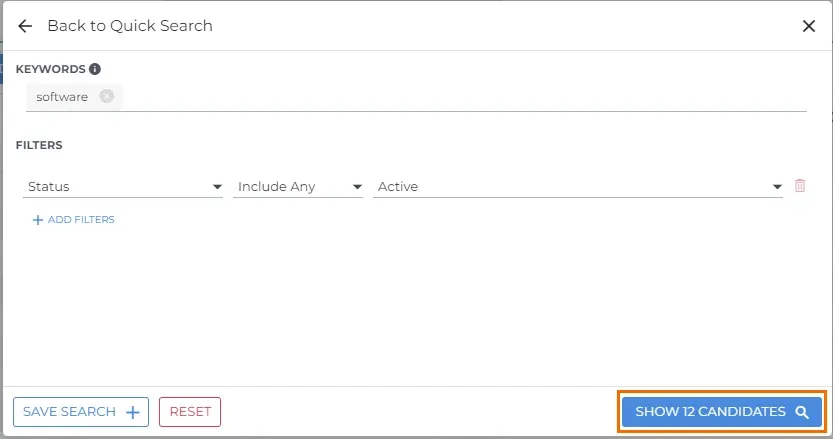
Screenshot source: Bullhorn Help Center, New Candidate List: Advanced Search, accessed July 2026. Bullhorn says the new Candidate List is still being rolled out.
This update means old screenshots cannot settle a 2026 purchase. Ask which Candidate List your account will receive, when the rollout reaches every user and which features remain absent from the new view.
Matching remains input-dependent. Bullhorn’s documentation says its Match Candidates workflow extracts up to ten keywords from a job description, attachment or resume. Vague descriptions and unrelated content can reduce result quality.
Resume parsing feedback is equally divided. Some users praise automatic capture from resumes and job boards. Others report broken formatting, missing applications or poor field extraction. Test ten CVs from your actual markets:
- one image-based PDF;
- one two-column CV;
- two languages;
- overlapping jobs;
- contract assignments;
- missing dates;
- an updated version of an existing candidate.
Score work history, dates, employer names, skills, contact details, formatting and duplicate handling. The result will tell you more than a generic parsing claim.
Bullhorn integrations are a strength, but the stack still needs design
It is inaccurate to say Bullhorn lacks integrations. Core includes more than 350 marketplace partners. Its broader offer covers job boards, email, telephony, automation, analytics, VMS, onboarding and staffing operations.
The better question is whether the final system behaves like one workflow. Every partner adds capability, but it can also add a contract, data model, support route and failure point. The agency must decide which work belongs in Bullhorn and which belongs in a specialist tool.
LinkedIn is a good example. Bullhorn Core includes Recruiter System Connect and Apply Connect. According to Bullhorn’s current RSC documentation, recruiters can see eligible Bullhorn data in LinkedIn Recruiter, export candidates to Bullhorn, sync InMails and notes, and view past applicant indicators.
RSC requires a full LinkedIn Recruiter seat. Recruiter Lite is not supported. One LinkedIn contract can connect to one Bullhorn database, and Bullhorn remains the system of record. Changes made in LinkedIn do not all write back into Bullhorn.
That is more capable than several competitor pages suggest. It is still a different workflow from running a candidate database, AI ranking and multichannel sequences inside one platform, so check which side of that line your desk sits on.
Atlas also wrote in 2024 that Bullhorn had not built cadence technology. Bullhorn’s current pricing page now lists automation, omnichannel engagement, messaging and Digital Worker outreach products. The relevant 2026 question is which plan or module provides the workflow, how it is priced and what the recruiter sees inside the core record.
What Bullhorn costs, in short
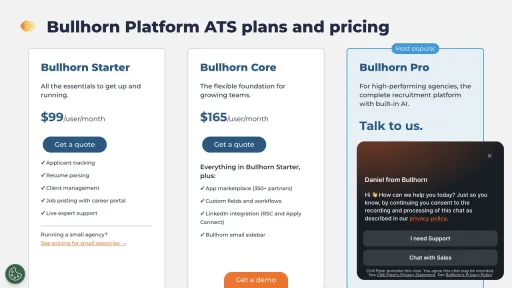
Bullhorn publishes Starter at $99 per user per month and Core at $165 per user per month, while Pro and the newer Max tier are quote-based. Pro includes AI search and match, process automation, and real-time analytics. Max inherits those Pro features and adds agentic workflows. Bullhorn says Onboarding and Middle Office are optional and priced separately.
We put the full breakdown, a year-one worked example for a small desk, and the questions to take into the vendor call in our dedicated guide to Bullhorn pricing. For a public baseline on other agency platforms, see our recruiting software pricing comparison, and if you run a UK desk, our UK recruitment CRM comparison scores ten systems on UK GDPR, temp pay and bill, sourcing and published pricing.
Who is most likely to be happy with Bullhorn?
Bullhorn looks strongest for established staffing firms with a clear operating model. It can support teams that need a system of record across sales, recruiting and operations. The partner marketplace also suits agencies that prefer specialist tools connected to a stable core.
The fit is especially strong when:
- you need VMS connections or high-volume staffing workflows;
- time capture, invoicing, pay and bill, or payroll are part of the requirement;
- the agency has an ATS administrator or operations owner;
- custom fields and workflows reflect a mature process;
- managers rely on detailed operational reporting;
- a broad partner ecosystem matters more than native simplicity.
Bullhorn also says more than 4,500 small agencies use its platform. Its small-agency offer promises a go-live process that starts within two weeks. This directly challenges the idea that Bullhorn is only for large firms.
Small does not automatically mean good fit. A new direct-hire agency may not need middle office, VMS, a marketplace or complex reporting. It may care more about sourcing, outreach and ease of use. The buying decision should follow the workflow, not the company headcount.
Large contract staffing firms should be cautious with lighter alternatives. A front-office platform does not provide Bullhorn’s middle-office, VMS, time, expense or payroll depth. Removing Bullhorn can create a larger operations gap than the front-office improvement solves.
Where Leonar differs from Bullhorn
The fairest comparison is between daily recruitment workflows, not total feature count. Bullhorn covers more staffing operations. The alternative focuses on a smaller agency moving from sourcing to outreach, ATS, client CRM and placement in one recruiter-friendly workspace.
The first difference is the Chrome extension for sourcing. It creates a record from the details the recruiter confirms and lets them choose a Leonar project and stage. The team can add notes, score the shortlist and prepare the next task separately in Leonar.
The second difference is multichannel recruitment outreach. The workspace can keep email, WhatsApp and phone workflow options alongside LinkedIn drafts, reminders and manual tasks. The recruiter chooses the channel, reviews the wording, performs any LinkedIn action manually, and records the activity against the candidate and project.
The third difference is pricing. Monthly, annual-commitment and prepaid options are public. The 870M+ profile database is searchable from Professional, while AI sourcing is included at the published Professional level. You can model the cost before a sales call.
These differences matter most for direct-hire and executive-search agencies. If your priority is payroll, VMS coverage, complex compliance or middle-office operations, Bullhorn remains the more relevant platform.
You can inspect the two products side by side or review the broader Bullhorn alternatives for staffing agencies after defining your reason for change.
An eight-point Bullhorn trial and reference-call checklist
A polished demo will not reveal the implementation risk. Your evaluation should reproduce one working week and include a reference customer with similar modules.
1. Run a timed database test
Import realistic data and time candidate search, record loads, stage changes, company history and manager reporting. Repeat each task instead of using the fastest result.
2. Confirm which Candidate List you receive
Ask whether the new search is enabled for every user. Build a saved search with AND, OR and exclusion logic. Confirm custom-field and Boolean behavior.
3. Parse ten difficult CVs
Use image PDFs, two-column layouts, several languages and updated candidate versions. Score field accuracy and duplicates.
4. Reproduce the LinkedIn workflow
Use your own Recruiter contract. Export a candidate, inspect synced history and notes, create a submission, then verify what writes back.
5. Build the full module bill
Price the platform, Pro, search, automation, messaging, analytics, implementation and every partner product. Include renewal terms.
6. Create the reports your leaders need
Build gross profit, revenue, recruiter activity, job pipeline and forecast views. Note which team owns each data field and report.
7. Test support ownership
Present one issue that crosses Bullhorn and a partner. Ask who accepts the ticket, what the escalation path is and which service level applies.
8. Plan migration and exit before signing
Request data formats, custom-field mapping, attachment handling, archive access, contract notice periods and export conditions.
Atlas’s 2024 screenshot below shows why dated workflow evidence needs context. It documents a Bullhorn submissions view used in that review, not a promise that every 2026 account looks the same.
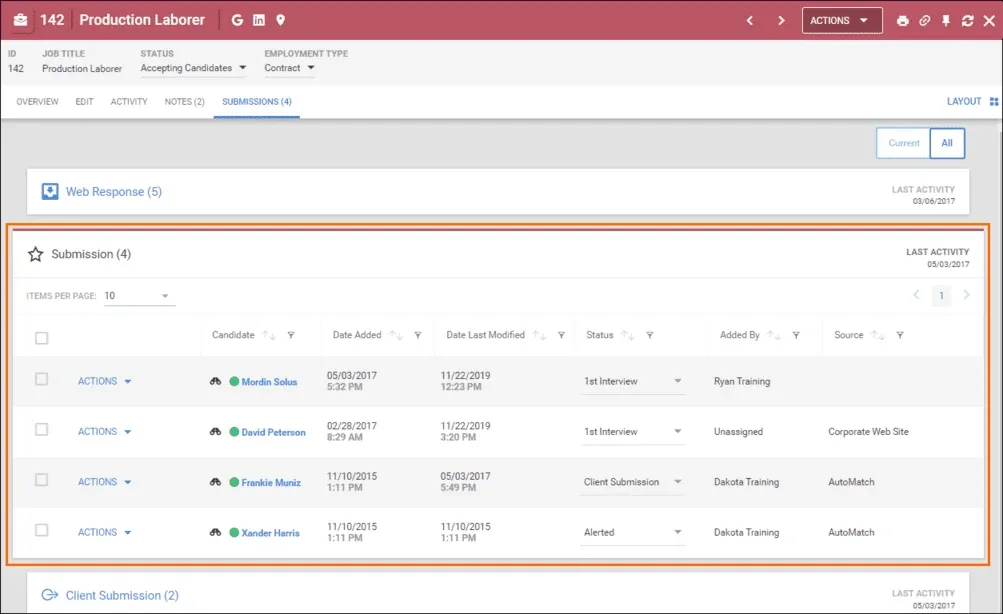
Third-party screenshot source: Atlas, Bullhorn: an in-depth review, published April 2024. Bullhorn interfaces and configured fields vary by edition and account.
Use the same scorecard for every finalist. Involve one system-friendly recruiter and one reluctant user. Their combined feedback predicts adoption better than the buyer’s opinion alone.
Which Bullhorn review should guide your decision?
No single Bullhorn review should decide the purchase. The large verified samples show that many staffing firms rely on the product successfully. Community threads reveal where broad platforms can fail when implementation, modules and ownership do not line up.
Choose Bullhorn when operational depth, integrations and a configurable staffing system matter most. Test more carefully when your team is small, sourcing-heavy or trying to consolidate outreach without adding several quoted modules.
The best evidence comes from your own workflows. Price the full stack, test the new search, parse difficult CVs and speak with customers using the same products. If the shortlist includes a lighter platform, compare the outcome of each task rather than the number of features.
For a recruitment agency focused on LinkedIn and outbound work, our recruitment agency workflow explains the narrower approach. You can also check published plan pricing before comparing Bullhorn’s complete quote.
Frequently asked questions about Bullhorn reviews
Is Bullhorn a good ATS for staffing agencies?
Yes, especially for established staffing firms. Bullhorn combines candidate records, client management, jobs, submissions and placements in a staffing-specific system. Its marketplace, VMS connections and middle-office options also support complex operations.
G2 shows 4.2 out of 5 from 1,223 reviews, while Capterra shows 4.0 from 1,023. Smaller direct-hire agencies should still test speed, setup effort and the full module cost. A strong product can be more platform than a small team needs.
What do Bullhorn users complain about most?
The recurring complaints involve speed, session timeouts, complex workflows, search, resume parsing, support delays and the total cost of extra modules.
These issues are not universal. Other reviewers praise Bullhorn’s ease of use, search, parsing, support and reporting. The split often reflects database size, configuration, purchased products and implementation quality. Use the complaints as a trial script, then reproduce each workflow with your own data.
How much does Bullhorn cost in 2026?
Bullhorn publishes Starter at $99 per user per month and Core at $165 per user per month. Core adds custom workflows, the 350+ partner marketplace, LinkedIn RSC and Apply Connect, and the email sidebar.
Bullhorn Pro is quote-based and adds the recruitment CRM sales pipeline, AI Assistant, automation, analytics and a dedicated account manager. Specialist AI, messaging, VMS, middle-office and operations products also require a quote, so compare the complete stack rather than the entry price.
Does Bullhorn integrate with LinkedIn Recruiter?
Yes. Bullhorn Core includes LinkedIn Recruiter System Connect and Apply Connect. RSC can show Bullhorn data in LinkedIn Recruiter, export candidates to Bullhorn and sync eligible InMails and notes.
It requires a full LinkedIn Recruiter seat, does not support Recruiter Lite and supports one LinkedIn contract per Bullhorn database. Ask Bullhorn to demonstrate the exact history, project, message and candidate fields that will sync in your configured environment.
Why are Bullhorn reviews more negative on Reddit?
Reddit attracts people who are troubleshooting an implementation, disputing a contract or considering a switch. That creates a more negative sample than a marketplace containing routine positive experiences.
Reddit is still useful because it exposes detailed failure cases around support, parsing, integrations and reporting. It also contains vendor promotion and repeated stories. Use it to build questions for your demo and reference calls, not to estimate overall customer satisfaction.
When should an agency compare Bullhorn with Leonar?
The comparison is most useful for recruitment agencies of 3 to 30 recruiters that rely on LinkedIn Recruiter and outbound sourcing. Test selected-profile organization, profile context, shortlist scoring, draft preparation, user tasks, email workflow options and total price.
Bullhorn remains the stronger option when the agency needs broad VMS coverage, time capture, invoicing, pay-and-bill or payroll operations. A lighter front-office platform is not designed to replace those middle-office capabilities.
Save time on every follow-up
Keep multichannel outreach in one sequence, see who to contact next, and move through follow-ups faster.
Frequently asked questions
Is Bullhorn a good ATS for staffing agencies?
Yes, especially for established staffing firms. Bullhorn combines candidate records, client management, jobs, submissions and placements in a staffing-specific system. Its marketplace, VMS connections and middle-office options also support complex operations. G2 shows 4.2 out of 5 from 1,223 reviews, while Capterra shows 4.0 from 1,023. Smaller direct-hire agencies should still test speed, setup effort and the full module cost. A strong product can be more platform than a small team needs.
What do Bullhorn users complain about most?
The recurring complaints involve speed, session timeouts, complex workflows, search, resume parsing, support delays and the total cost of extra modules. These issues are not universal. Other reviewers praise Bullhorn's ease of use, search, parsing, support and reporting. The split often reflects database size, configuration, purchased products and implementation quality. Use the complaints as a trial script, then reproduce each workflow with your own data.
How much does Bullhorn cost in 2026?
Bullhorn now publishes Starter at $99 per user per month and Core at $165 per user per month. Core adds custom workflows, the 350+ partner marketplace, LinkedIn Recruiter System Connect, Apply Connect and the email sidebar. Bullhorn Pro is quote-based and adds the recruitment CRM sales pipeline, AI Assistant, automation, analytics and a dedicated account manager. Specialist AI, messaging, VMS, middle-office and operations products also require a quote, so compare the complete stack rather than the entry price.
Does Bullhorn integrate with LinkedIn Recruiter?
Yes. Bullhorn Core includes LinkedIn Recruiter System Connect and Apply Connect. RSC can show Bullhorn data in LinkedIn Recruiter, export candidates to Bullhorn and sync eligible InMails and notes. It requires a full LinkedIn Recruiter seat, does not support Recruiter Lite and supports one LinkedIn contract per Bullhorn database. Ask Bullhorn to demonstrate the exact history, project, message and candidate fields that will sync in your configured environment.
Why are Bullhorn reviews more negative on Reddit?
Reddit attracts people who are troubleshooting an implementation, disputing a contract or considering a switch. That creates a more negative sample than a marketplace containing routine positive experiences. Reddit is still useful because it exposes detailed failure cases around support, parsing, integrations and reporting. It also contains vendor promotion and repeated stories. Use it to build questions for your demo and reference calls, not to estimate overall customer satisfaction.
When should an agency compare Bullhorn with Leonar?
The comparison is most useful for recruitment agencies of 3 to 30 recruiters that rely on LinkedIn Recruiter and outbound sourcing. Test selected-profile organization, shortlist scoring, draft preparation, user tasks, email workflow options and total price. Bullhorn remains the stronger option when the agency needs broad VMS coverage, time capture, invoicing, pay-and-bill or payroll operations. A lighter front-office platform is not designed to replace those middle-office capabilities.
Answer 3 quick questions and we will recommend the best option for your hiring workflow.
How large is your recruiting team?

Author
Pierre-Alexis ArdonCo-founder
Pierre-Alexis Ardon is co-founder of Leonar, where he focuses on building AI-powered recruiting systems, assisted sourcing, and search optimization. With a background in engineering and over 7 years working at the intersection of artificial intelligence and talent acquisition, he designs the algorithms that power Leonar's candidate matching and workflow assistance. Pierre-Alexis advises recruitment agencies on their digital transformation and regularly publishes analyses on how AI agents are reshaping HR workflows. He is passionate about making advanced technology accessible to recruiters who are not engineers.
Related articles
-
 CRM & ATS
Bullhorn Pricing: The Real Year-One Cost
-
-