LinkedIn Boolean Search for Recruiters (2026)
Master LinkedIn Recruiter Boolean search with 15+ ready-to-use templates by role. Learn operators, avoid common mistakes, and find candidates faster.


Boolean search is one of the most powerful features inside LinkedIn Recruiter — yet most recruiters only scratch the surface. With the right operators and a well-built search string, you can cut through millions of profiles and surface exactly the candidates you need.
In this guide you will learn every Boolean operator LinkedIn supports, see 15+ copy-paste templates organized by role, and discover the most common mistakes that silently break your searches. Whether you are new to Boolean logic or want sharper strings, this article gives you everything in one place.
For a broader overview of the platform, see our complete guide to LinkedIn Recruiter. And if you want to refine results further, check out our breakdown of LinkedIn Recruiter search filters.
Quick reference: Boolean operators at a glance
Keep this table handy — every template below uses a combination of these five operators.What is LinkedIn Recruiter Boolean search?
Boolean search lets you combine keywords with logical operators — AND, OR, NOT, quotation marks, and parentheses — to build precise queries inside LinkedIn Recruiter’s keyword field.
Instead of typing a single job title and scrolling through hundreds of loosely related profiles, you tell LinkedIn exactly which terms must appear, which are optional, and which should be excluded. The result is a much shorter, much more relevant candidate list.
For example, searching "Data Engineer" AND (Spark OR Databricks) NOT Junior returns profiles that contain the exact title “Data Engineer”, mention either Spark or Databricks, and exclude anyone tagged as Junior.
Boolean works in the Keyword field of LinkedIn Recruiter. It also works in the Title and Company fields of LinkedIn Sales Navigator, though with slightly different behavior.
The 5 Boolean search operators explained
Quotation marks (” ”)
Quotation marks force LinkedIn to match an exact phrase rather than individual words.
Examples:
"Project Manager"— returns profiles with this exact phrase, not just any profile mentioning “project” and “manager” separately."Machine Learning Engineer"— filters out generic “engineer” profiles that never mention machine learning.
When to use: Always wrap multi-word job titles and skills in quotes. Without them, LinkedIn treats each word independently and your results become noisy.
AND
The AND operator requires both terms to appear in a profile. It narrows your search.
Examples:
Java AND Python— only profiles mentioning both languages."Account Executive" AND SaaS— sales profiles specifically in the SaaS space.
Tip: LinkedIn treats a space between keywords as an implicit AND. Writing Java Python is the same as Java AND Python. However, using AND explicitly makes complex strings more readable.
OR
The OR operator broadens your search by matching profiles that contain at least one of the listed terms.
Examples:
"Sales Manager" OR "Account Manager" OR "Business Development Manager"— captures all common titles for a similar role.React OR Angular OR Vue— finds front-end developers regardless of their specific framework.
When to use: Use OR to cover synonyms, alternative titles, and related skills. This is the single most effective way to increase the size of your candidate pool.
NOT
The NOT operator removes profiles that contain a specific term.
Examples:
Developer NOT Junior— excludes junior-level developers."Marketing Manager" NOT Freelance— removes freelancers from results.
When to use: After your initial search returns too many irrelevant profiles. Add NOT terms one at a time and review the impact.
Parentheses ( )
Parentheses group terms so LinkedIn evaluates them in the correct order — just like in math.
Examples:
(Marketing AND B2B) OR (Sales AND B2C)— finds either B2B marketers or B2C salespeople.("Software Engineer" OR Developer) AND (Python OR Go) NOT (Intern OR Junior)— groups titles, skills, and exclusions cleanly.
Tip: When your string has more than two operators, always use parentheses. Without them, LinkedIn may interpret your query differently than you intended.
How to build a Boolean search string (step by step)
Follow this four-step framework to create any Boolean search from scratch:
Step 1 — List target titles
Write down every variation of the role you are hiring for. Wrap multi-word titles in quotes and connect them with OR.
("Software Engineer" OR "Backend Developer" OR "Python Developer")Step 2 — Add required skills or qualifications
Use AND to attach the skills, tools, or certifications the role requires.
AND (Python OR Django OR Flask)Step 3 — Exclude what you don’t want
Use NOT to filter out seniority levels, industries, or roles that pollute results.
NOT (Junior OR Intern OR Freelance)Step 4 — Combine everything
("Software Engineer" OR "Backend Developer" OR "Python Developer") AND (Python OR Django OR Flask) NOT (Junior OR Intern OR Freelance)Paste this into the Keyword field in LinkedIn Recruiter, then layer on additional filters (location, years of experience, industry) using the platform’s built-in filter panel. For a full walkthrough of those filters, see our LinkedIn Recruiter search filters guide.
15 ready-to-use Boolean search strings for recruiters
Below are copy-paste templates organized by function. Adapt the specific tools, titles, and exclusions to match your job requirements.
Software engineering
Full-stack developer:
("Full Stack Developer" OR "Full-Stack Engineer" OR "Software Engineer") AND (React OR Angular OR Vue) AND (Node.js OR Python OR Java) NOT (Junior OR Intern OR Student)DevOps / Cloud engineer:
("DevOps Engineer" OR "Site Reliability Engineer" OR "Cloud Engineer" OR "Platform Engineer") AND (AWS OR Azure OR GCP) AND (Terraform OR Kubernetes OR Docker) NOT (Junior OR Trainee)Data & analytics
Data scientist:
("Data Scientist" OR "Machine Learning Engineer" OR "ML Engineer") AND (Python OR R) AND ("Machine Learning" OR "Deep Learning" OR NLP) NOT (Intern OR Junior OR Student)Data engineer:
("Data Engineer" OR "Analytics Engineer" OR "ETL Developer") AND (SQL OR Spark OR Databricks OR Snowflake) NOT (Junior OR Intern)Product management
("Product Manager" OR "Senior Product Manager" OR "Group Product Manager") AND (B2B OR SaaS OR "Product-Led Growth") NOT (Associate OR Junior OR Coordinator)Marketing & growth
Growth / demand generation:
("Growth Marketing Manager" OR "Demand Generation Manager" OR "Performance Marketing Manager") AND (SEO OR "Paid Media" OR "Marketing Automation" OR HubSpot) NOT (Intern OR Junior OR Freelance)Content marketing:
("Content Marketing Manager" OR "Content Strategist" OR "Head of Content") AND (B2B OR SaaS OR "Content Strategy") NOT (Freelance OR Copywriter)Sales & business development
("Account Executive" OR "Sales Manager" OR "Business Development Manager") AND (SaaS OR "Enterprise Sales" OR B2B) NOT (SDR OR BDR OR Intern OR Junior)Finance & accounting
(CFO OR "Finance Director" OR "Financial Controller" OR "Head of Finance") AND (SaaS OR "Series B" OR "Series C" OR "Private Equity") NOT (Intern OR Junior OR Bookkeeper)Healthcare & life sciences
("Clinical Research Associate" OR "CRA" OR "Clinical Trial Manager") AND ("Phase III" OR Oncology OR "Medical Device") NOT (Intern OR Student)HR & talent acquisition
("Talent Acquisition Manager" OR "Recruiter" OR "Head of Talent") AND (Tech OR SaaS OR "Employer Branding" OR "Talent Sourcing") NOT (Junior OR Intern OR Staffing)Design & UX
("Product Designer" OR "UX Designer" OR "UX/UI Designer" OR "Interaction Designer") AND (Figma OR Sketch OR "Design Systems" OR "User Research") NOT (Junior OR Intern OR Graphic)Executive / C-level
(CEO OR COO OR CTO OR CMO OR "VP Engineering" OR "VP Sales" OR "VP Marketing") AND (SaaS OR Fintech OR "Series A" OR "Series B") NOT (Consultant OR Advisor OR Interim)Cybersecurity
("Security Engineer" OR "Cybersecurity Analyst" OR "Penetration Tester" OR CISO) AND (SOC OR SIEM OR "Cloud Security" OR "Zero Trust") NOT (Junior OR Intern OR Student)Supply chain & operations
("Supply Chain Manager" OR "Operations Manager" OR "Logistics Manager" OR "Procurement Manager") AND (SAP OR "Lean Six Sigma" OR "Demand Planning") NOT (Junior OR Intern OR Coordinator)Pro tip: Start with a broader string (fewer AND clauses) and tighten it only if you get too many results. You can also combine these keyword strings with LinkedIn Recruiter’s built-in filters for location, company size, and years of experience to narrow results further. For a data-driven approach to ranking the profiles that come back, explore AI-powered talent sourcing and profile scoring tools.
Using ChatGPT to generate Boolean strings
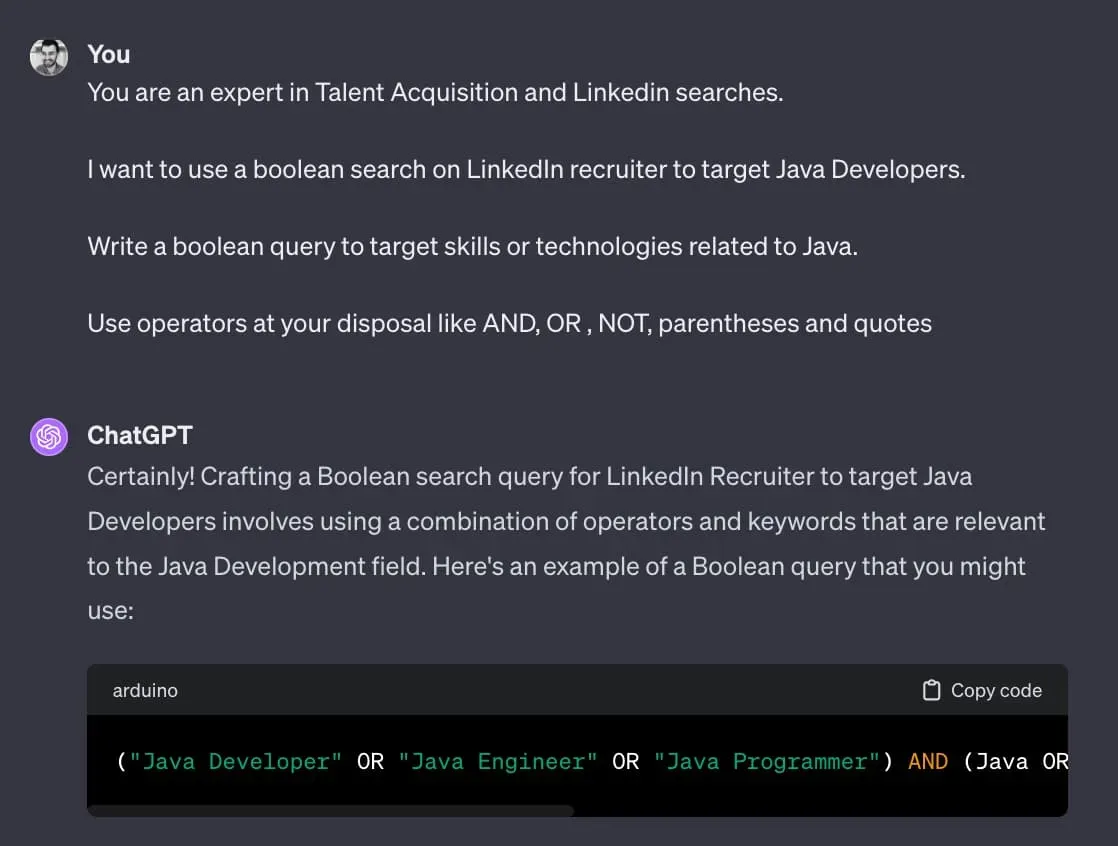
AI tools like ChatGPT are remarkably good at building Boolean strings because Boolean is a structured, rule-based language — exactly the kind of task large language models handle well.
How to prompt ChatGPT for Boolean search
Use this prompt template:
You are an expert technical recruiter. Build a LinkedIn Recruiter Boolean search string for the following role. Use AND, OR, NOT, parentheses, and quotation marks. Include synonyms for the job title and key skills. Exclude junior, intern, and freelance profiles.
Role: [your role] Must-have skills: [list] Nice-to-have skills: [list] Industry: [optional]
Example prompt:
Role: Senior Backend Engineer Must-have skills: Go, PostgreSQL, Kubernetes Nice-to-have skills: gRPC, Redis, Terraform Industry: Fintech
ChatGPT output:
("Senior Backend Engineer" OR "Backend Developer" OR "Software Engineer") AND (Go OR Golang) AND (PostgreSQL OR Postgres) AND (Kubernetes OR K8s) AND (Fintech OR "Financial Services" OR Banking) NOT (Junior OR Intern OR Freelance OR Consultant)Tips for better results
- Be specific about seniority. Tell ChatGPT the exact level (senior, lead, principal) and which levels to exclude.
- Ask for variations. Prompt: “Give me 3 versions — one strict, one moderate, one broad.”
- Iterate. Paste the string into LinkedIn Recruiter, review results, then ask ChatGPT to adjust.
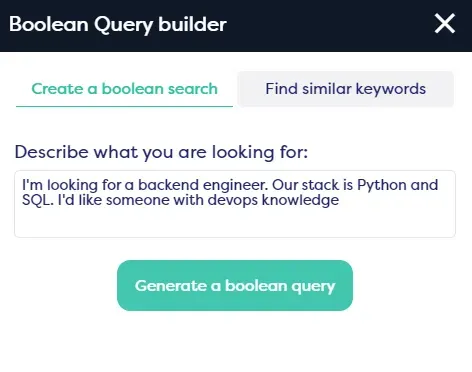
Some recruiting platforms also include built-in AI boolean generators that create search strings directly from a job description, saving you the copy-paste step.
Boolean search in LinkedIn Sales Navigator
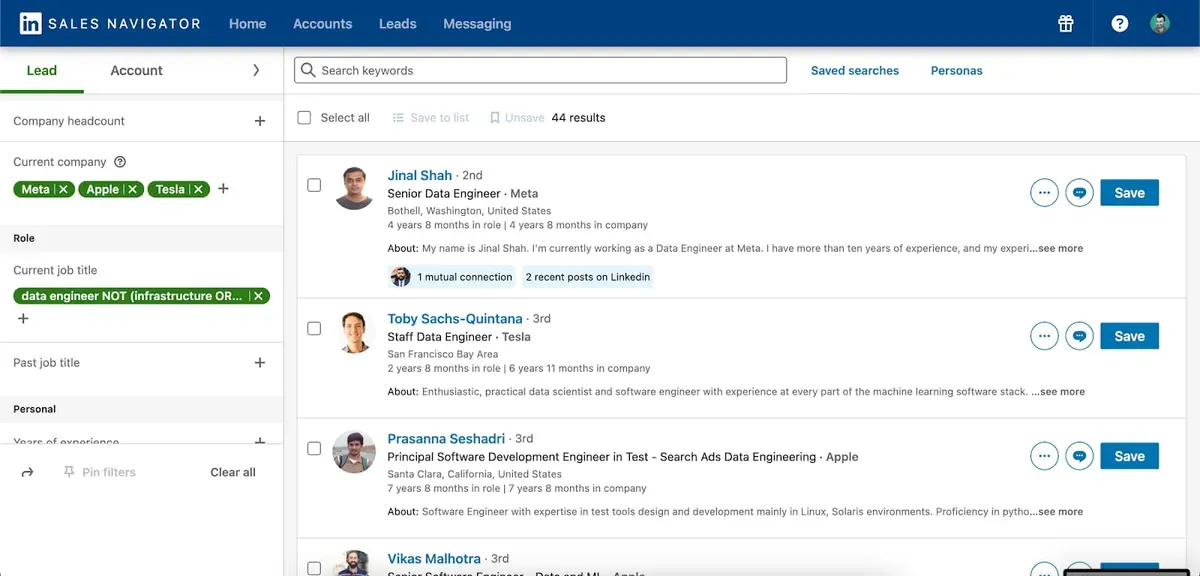
Boolean search also works in LinkedIn Sales Navigator — specifically in the Company, Title, and Keyword fields. If you use Sales Navigator for recruiting or talent mapping, the same operators apply.
Here are three practical examples:
Excluding freelancers and contractors
NOT (Freelance OR Freelancer OR Independent OR Contractor OR "Self-employed" OR Consultant)Paste this into the Title field to remove non-permanent profiles from your lead list.
Targeting senior marketing leaders
(Head OR Director OR VP OR "Vice President" OR Chief) AND (Marketing OR Communication OR Branding OR "Demand Generation") NOT (Assistant OR Intern OR Junior OR "Entry Level")This returns decision-makers in marketing while filtering out junior profiles.
Finding Java developers by tech stack
(Java OR JEE OR J2EE OR "Spring Boot" OR "Spring MVC" OR Hibernate OR Maven OR Gradle)Instead of searching “Java developer”, list the technologies that prove someone works with Java. This surfaces profiles that might not include “Java” in their title but clearly use the ecosystem daily.
For a detailed comparison of Sales Navigator and Recruiter, see our LinkedIn Sales Navigator vs Recruiter guide.
LinkedIn Recruiter Boolean search limitations
Boolean search is powerful but it has real constraints you should know about.
The keyword field searches the entire profile. When you type a Boolean string in the Keyword field, LinkedIn scans job titles, summaries, experience descriptions, skills, education — everything. A developer who once wrote a blog post mentioning “project management” might show up in a search for “Project Manager.” There is no way to restrict the keyword search to titles only in Recruiter (though Sales Navigator offers a separate Title field).
No relevance ranking. LinkedIn Recruiter does not rank results by how well they match your Boolean string. The most relevant profile might be on page 30. This is one reason recruiters complement Boolean search with candidate scoring tools that re-rank exported results by fit.
Character and nesting limits. LinkedIn caps Boolean strings at roughly 2,000 characters. Deeply nested parentheses (more than 3-4 levels) can also cause unexpected behavior. If your string is very long, break it into two separate searches.
No wildcard or proximity operators. Unlike Google or specialized sourcing databases, LinkedIn does not support wildcards (develop*) or NEAR/proximity operators. You need to spell out every variation explicitly — which is why the OR operator is so important.
Profiles are not always up to date. Candidates do not always update their LinkedIn profiles promptly. Someone who switched from Java to Python six months ago may still appear in your Java search. Cross-reference with recent activity and endorsements when evaluating results.
To work around these limitations, many recruiters export candidates from LinkedIn Recruiter and use external tools for deeper filtering and outreach sequencing.
Common Boolean search mistakes
Even experienced recruiters make these errors. Here is how to spot and fix them.
Missing quotation marks on multi-word terms. Searching Project Manager without quotes finds profiles containing “project” and “manager” anywhere — not necessarily together. Always write "Project Manager".
Forgetting parentheses around OR groups. The string "Software Engineer" AND Java OR Python NOT Junior is ambiguous. LinkedIn may interpret it as ("Software Engineer" AND Java) OR (Python NOT Junior), which is probably not what you want. Correct version: "Software Engineer" AND (Java OR Python) NOT Junior.
Overusing NOT. Each NOT term shrinks your pool. Adding five or six NOT terms can eliminate good candidates whose profiles happen to contain one of those words in a different context. Start with 1-2 NOT terms and add more only if needed.
Making strings too long. A 500-word Boolean string is hard to debug and often hits LinkedIn’s character limits. If you need that much specificity, split the search into two or three shorter strings and combine the results manually.
Using operators that LinkedIn doesn’t support. LinkedIn does not recognize wildcards (*), the NEAR operator, or the minus sign (-) as a NOT replacement. Stick to AND, OR, NOT, quotes, and parentheses.
Mixing case on operators. Boolean operators must be uppercase: AND, OR, NOT. Lowercase and, or, not are treated as regular keywords, not operators.
Frequently asked questions about LinkedIn Boolean search
What Boolean operators does LinkedIn support?
LinkedIn supports five operators: AND (include both terms), OR (include either term), NOT (exclude a term), quotation marks for exact phrase matching, and parentheses to group terms. All text operators must be typed in uppercase. LinkedIn does not support wildcards, proximity operators like NEAR, or shorthand symbols like + and -.
Does Boolean search work the same on LinkedIn free, Sales Navigator, and Recruiter?
Boolean search works in the keyword field on all LinkedIn tiers, but scope and power differ. Free LinkedIn limits results to your extended network. Sales Navigator extends Boolean to Company, Title, and Keyword fields with access to the full database. Recruiter and Recruiter Lite have no limit on operators per query and offer the broadest search capabilities.
Is there a character limit for Boolean strings on LinkedIn?
Yes, but it varies. Free LinkedIn and Sales Navigator cap strings at roughly 1,000 characters. LinkedIn Recruiter and Recruiter Lite have no stated limit on operators. If your string is too long, split it into multiple searches and merge results in your recruiting CRM.
Why is my LinkedIn Boolean search returning wrong results?
Common reasons include: not typing operators in uppercase (lowercase and/or/not won’t work), missing parentheses causing LinkedIn to misinterpret operator precedence, exceeding the character limit, or using unsupported operators. LinkedIn’s search algorithm may also override strict Boolean logic with its own relevance ranking on free accounts.
Can you use Boolean search in Recruiter’s filters beyond the keyword field?
In LinkedIn Recruiter, Boolean logic works primarily in the Keyword field. Other fields like Title, Company, and Location use structured filter logic. However, you can combine Boolean keyword strings with Recruiter’s 20+ search filters for highly targeted candidate searches.
How Boolean search operators help you find candidates for specific jobs
Boolean operators are not just abstract logic tools. They are the bridge between a job description sitting on your desk and a shortlist of qualified candidates on your screen. The real power of Boolean search emerges when you treat every open role as a unique puzzle, breaking down the job requirements into searchable components and then reassembling them into a precise query string.
The workflow starts with the job description itself. Read through the requirements and pull out three categories of terms: job titles (and their synonyms), required skills or certifications, and disqualifiers you want to exclude. A senior backend engineering role, for instance, might yield title variants like “Senior Backend Engineer,” “Staff Software Engineer,” and “Backend Developer,” must-have skills like Python, PostgreSQL, and Docker, and exclusions like Intern or Freelance. Once you have those building blocks, the operators do the rest. OR connects your title synonyms so you cast a wide net. AND locks in the non-negotiable skills. NOT trims away profiles that would waste your time.
What makes this approach so valuable is that different operator combinations serve different hiring needs. Technical roles tend to require long OR chains of specific tools and frameworks, because the same skill set goes by many names. Leadership searches, on the other hand, lean more on title-level OR groups (VP, Director, Head of) combined with AND clauses for industry or domain expertise. Niche specialties, like clinical research or cybersecurity, often benefit from combining certifications with technology keywords to filter out generalists.
It is worth remembering that Boolean search is only the first step in a complete sourcing workflow. A well-crafted query gets you the initial list, but what happens next matters just as much. Pairing your Boolean results with candidate sourcing software allows you to organize, score, and prioritize the profiles you find. From there, recruiting automation tools help you move from a static list to active outreach sequences, ensuring that the candidates you surfaced actually hear from you in a timely, personalized way.
Evaluating candidates found through Boolean search
A strong Boolean string can return hundreds or even thousands of matching profiles, but volume alone does not fill roles. The next challenge is separating the truly qualified candidates from those who merely match a few keywords. This evaluation step is where many recruiters lose time, because LinkedIn’s default result ordering is not designed to surface the best-fit candidates first.
When reviewing Boolean search results, experienced recruiters focus on a handful of practical criteria. Title relevance is the starting point: does the candidate’s current or most recent title align closely with the role you are hiring for, or did the match come from an older position buried three jobs back? Skill match depth matters too. A profile that lists Python as one of fifteen skills is different from one where Python appears in every role description and project summary. Experience recency is another critical factor, because a candidate who used Kubernetes daily two years ago may have shifted focus entirely since then. Finally, career trajectory offers useful context. Someone who has progressed from individual contributor to team lead to director signals ambition and growth, which may be exactly what your hiring manager wants to see.
LinkedIn does not help much with this prioritization. The platform’s default sort order blends recency, network proximity, and engagement signals in ways that rarely align with your specific hiring criteria. A profile that updated their headline last week may rank above a perfect-fit candidate who has been quietly excelling in the same role for five years.
This is why many recruiters choose to export their Boolean search results and evaluate them outside of LinkedIn. Tools with profile filtering and scoring capabilities let you assign weights to the criteria that matter most for a given role and then rank candidates accordingly. If you are not yet exporting your search results, our guide on how to export candidates from LinkedIn Recruiter walks you through the process step by step. Moving your evaluation workflow into a structured environment saves hours of manual scrolling and ensures that your outreach reaches the strongest candidates first, not just the ones LinkedIn happened to surface at the top of the list.
Wrapping up
LinkedIn Boolean search remains one of the fastest ways to surface qualified candidates — if you use it correctly. Start with the quick reference table and templates above, adapt them to your open roles, and avoid the common mistakes that silently derail your searches.
For best results, combine Boolean strings with LinkedIn Recruiter’s filters and candidate sourcing software that can score and rank your results. Pairing a strong Boolean workflow with the best ATS for recruitment ensures your sourced candidates flow smoothly into a structured hiring pipeline. And if you are spending too much time building strings manually, test an AI-powered boolean builder or ChatGPT workflow to speed things up.
Want to go further? Explore our guides on passive talent sourcing, LinkedIn InMail best practices, and recruiting automation to build a complete sourcing workflow around your Boolean searches.
Answer 3 quick questions and we will recommend the best option for your hiring workflow.
How large is your recruiting team?

Author
Doriane StagnolRecruitment Content Specialist
Doriane Stagnol is a recruitment content specialist at Leonar with deep expertise in LinkedIn sourcing strategies and candidate outreach. She has spent over 5 years producing actionable content for recruiters, covering everything from InMail optimization to agency business development. Doriane combines hands-on recruiting experience with content creation to deliver practical guides that help talent acquisition professionals improve their daily workflows. Her work focuses on bridging the gap between sourcing theory and real-world application.
Related articles
-
 LinkedIn Recruiter
How to Use LinkedIn Recruiter in 2026
-
 LinkedIn Recruiter
LinkedIn Recruiter Search Filters Guide (2026)
-
 LinkedIn Recruiter
How to export candidates from Linkedin Recruiter?