ATS & CRM for Recruiting Agencies
The all-in-one platform built for staffing agencies
ATS, CRM, AI sourcing, and multi-channel outreach in a single workspace. Manage clients, candidates, and placements without juggling five different tools.


Used by 400+ high-growth recruiting teams and agencies globally


Why agencies choose Leonar over other ATS and CRM tools
Sourcing and outreach built in, not bolted on
Most ATS platforms stop at tracking applicants. Leonar combines an ATS and CRM with multi-source AI sourcing and email, SMS and WhatsApp outreach built in, with LinkedIn reminders, in one platform. No add-ons, no extra subscriptions.
An ATS CRM built for AI agents
Leonar is a recruiting platform designed from the ground up for AI. Connect AI assistants like Claude or ChatGPT through our MCP server to source candidates, manage pipelines, and launch outreach sequences using natural language.
We handle your migration, start to finish
Switching from Bullhorn, Vincere, or another ATS? Send us your data and our team takes care of everything: candidates, jobs, notes, pipeline history. No technical effort on your side, zero downtime.
Built for agencies that source and engage at scale
Leonar is designed for agencies where sourcing and candidate outreach are the core of daily work. AI shortlisting, automated multi-channel sequences, and a CRM that tracks every interaction across every mandate.
Agency recruiting is broken
Too many tools, zero visibility
Your ATS doesn't do outreach. Your outreach tool doesn't sync with your CRM. You spend more time switching tabs than actually recruiting.
Clients can't see the pipeline
Clients want real-time updates on their roles. You're stuck sending manual spreadsheets and status emails instead of recruiting.
Scaling means more chaos
Every new recruiter multiplies the complexity. Onboarding takes weeks, processes break, and data lives in silos.
ATS and CRM, finally in one place
Manage jobs, candidates, and client relationships from a single platform. Kanban pipelines with client context, activity tracking, and placement management. No more juggling separate tools.


Source and engage at scale
AI-powered sourcing across profiles from multiple professional sources, combined with email, SMS and WhatsApp sequences plus LinkedIn reminders the recruiter completes.
Give clients real-time pipeline visibility
A personalized portal where clients review shortlisted candidates, leave feedback, and track progress. No more status emails or spreadsheet updates.


Combine direct sourcing with job posting across multiple job boards to reach candidates who are actively looking for their next role.
Explore the platform
Click on a module to discover what Leonar can do for your team.




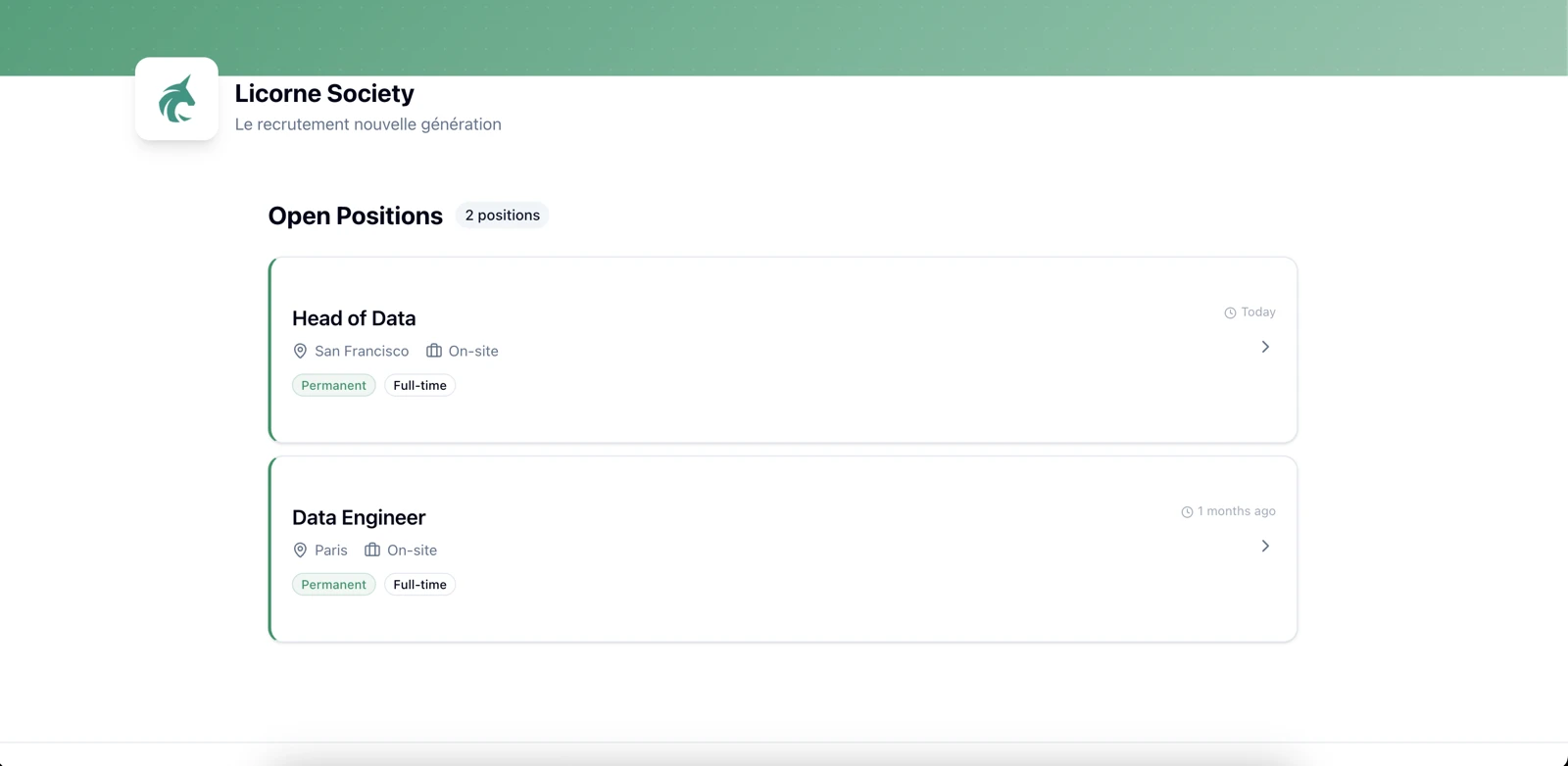


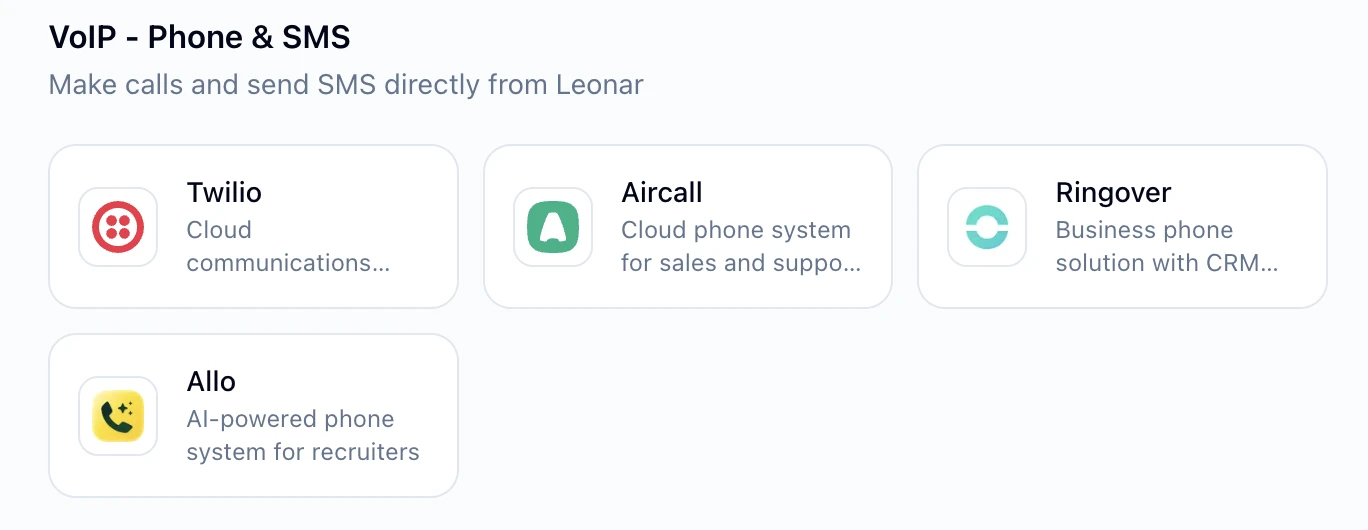
Leonar replaces your entire agency tech stack
See how an all-in-one platform compares to juggling separate tools.
| Feature | Leonar | Typical ATS | Typical CRM |
|---|---|---|---|
| Applicant tracking (ATS) | Included | Included | Not included |
| Recruiting CRM | Included | Limited | Included |
| AI sourcing (profiles from multiple professional sources) | Included | Not included | Not included |
| Multi-channel outreach | Included | Not included | Add-on |
| Client portal | Included | Limited | Not included |
| AI agent integration (MCP) | Included | Not included | Not included |
| Full migration service | Included | Not included | Not included |
| Sales CRM for business dev | Included | Not included | Limited |
"Source 30 Java developers in Munich for the TechCorp mandate"
"Launch the follow-up sequence for all candidates who haven't replied in a week"
"Show me pipeline conversion rates across all active mandates"
Let AI agents handle the repetitive work
Connect AI assistants like Claude or ChatGPT directly to your Leonar workspace. Your AI agent can source candidates across your client mandates, launch outreach sequences, and update pipelines while your recruiters focus on closing placements and building client relationships.
Meet Copilot, the built-in AI assistant (⌘J) Connect AI agents to your agency recruiting CRMEnterprise-grade security. GDPR compliant. You control what your AI agent can access.
Switching from another ATS? We handle the migration for you
Our team takes over your data from your current tool's exports: you send us the files, and we map the fields and handle deduplication. The exact scope, from notes to attachments and pipeline history, is confirmed with you on the migration call. Data migration is included with an annual subscription; otherwise, we provide a quote.
Export your data
Download a CSV or database export from your current ATS. We accept exports from Bullhorn, Vincere, Recruit CRM, JobAdder, and more.
Send it to us
Share your files with our migration team. We review the data structure, map fields, and handle deduplication.
Start recruiting
Your candidates, jobs, and history appear in Leonar. Your team picks up where they left off, with no learning curve.
Why recruiting agencies need a combined ATS and CRM
Recruiting agencies operate in a fundamentally different way from in-house talent teams. An in-house recruiter serves one employer. An agency recruiter serves two customers at once: the client company that pays the placement fee, and the candidate who needs to trust the agency enough to make a career move. This dual-customer dynamic creates operational complexity that standalone tools simply cannot handle.
A traditional ATS tracks applications and manages job postings. It works well for inbound hiring, where candidates apply to published roles. But agencies rarely sit and wait for applications. They proactively source passive candidates on LinkedIn, build talent pools across industries, and re-engage candidates from past placements for new mandates. An ATS alone leaves the entire sourcing and outreach workflow uncovered.
A standalone CRM fills the gap partially. It manages candidate relationships and tracks conversations over time. But without applicant tracking, it cannot handle the end-to-end placement workflow: posting jobs to boards, managing interview stages with clients, tracking fees, or generating compliance reports. The result is that most agencies end up stitching together three, four, or five separate tools: an ATS for job management, a CRM or spreadsheet for candidate tracking, a browser plugin for sourcing, an email tool for outreach sequences, and a shared drive for client updates. Each tool has its own login, its own data silo, and its own monthly invoice.
A combined ATS and CRM eliminates this fragmentation. When sourcing, outreach, candidate management, and client collaboration live in one platform, recruiters spend their time on placements instead of switching tabs. Every interaction you log, from first contact to the signed offer letter, sits in a single timeline. Recruiters can see which mandates are progressing, which candidates are engaged across multiple clients, and which outreach sequences are converting.
For agencies that bill by placement, speed matters directly to revenue. Every day a role stays open is a day a competitor might fill it first. A unified platform shortens the time from mandate to placement by removing the friction between sourcing, qualifying, and presenting candidates to clients.
What to look for in an ATS CRM for your recruiting agency
Not every ATS and CRM platform is built for agencies. Many were designed for in-house corporate teams and retrofitted with agency features as an afterthought. When evaluating an ATS CRM for your recruiting agency, these are the criteria that matter most.
Multi-channel outreach automation
The best candidates rarely respond to a single cold email. Agencies that consistently fill roles use multi-channel sequences: an email, then a follow-up message, then potentially SMS or WhatsApp, with a LinkedIn reminder the recruiter completes by hand. Your ATS CRM should let you build these sequences visually, schedule the email, SMS and WhatsApp steps, and track open rates, reply rates, and conversions on those channels.
Client collaboration features
Your clients want visibility into your progress. A client portal where they can review shortlisted candidates, leave feedback, and track pipeline stages in real time eliminates the back-and-forth of status emails and spreadsheet updates. Agencies that provide this level of transparency close more retainers and build longer client relationships.
Placement and fee tracking
An agency ATS must track the entire placement lifecycle: from initial client brief to candidate presentation, interview scheduling, offer management, and placement confirmation. The system should calculate placement fees automatically and generate reports that show revenue by client, recruiter, and time period. If you need a separate spreadsheet for financial reporting, the tool was not built for agencies.
Candidate database and AI sourcing
Over time, your agency builds its most valuable asset: a proprietary candidate database. The right ATS CRM should make this database searchable, filterable, and enrichable. Boolean search, AI-powered matching, tags, notes, and activity history should all work together so that when a new mandate arrives, you can check your existing talent pool before sourcing externally. A platform with built-in AI sourcing across profiles from multiple professional sources lets you combine internal database search with external talent discovery in a single workflow.
Migration support
Switching platforms is the biggest barrier to adopting a better ATS CRM. Look for a vendor that offers a managed migration service where their team imports your candidates, jobs, notes, tags, pipeline history, and attachments from your current platform. Whether you are coming from Bullhorn, Vincere, Recruit CRM, or JobAdder, the migration should be handled for you. If the vendor expects you to do the technical migration yourself, that is a red flag. See our guide on the best ATS CRM platforms for recruiting agencies for a detailed comparison, or read about the differences between ATS and CRM software if you are still evaluating your options.
The honest 30-second answer for agency owners
If your agency runs 3-30 recruiters and you are shopping ATS/CRM right now, here is the honest map of your options in 2026. Most pillar pages in this space pretend their tool is the answer for every shape of agency. The reality is closer to a decision tree: the right software depends on your headcount, your delivery model, and whether you can absorb a six-figure implementation budget. Four serious tools cover almost every SMB agency situation, and each one is the correct call in a specific scenario.
The rest of this page goes deeper than a comparison chart. It walks through the pricing math an SMB agency owner actually has to budget for, the architectural difference between AI-native and AI-retrofitted software, the migration path from your current ATS, and a sizing guide that tells you where each tool stops being the right call. If you want the short version, the pricing page and the Leonar vs Bullhorn head-to-head cover the spreadsheet view. Read on for the long version.
Pricing transparency for agency software in 2026
Here is the SMB scenario the rest of the SERP avoids. A 5-recruiter agency on LinkedIn Recruiter Corporate pays roughly $1,080 per seat per month in industry-reported aggregate pricing, or about $5,400 per month for the team. Add Bullhorn at an industry-reported $99 to $200 per recruiter per month plus an implementation fee, and you are landing in the $6,000 to $7,000 monthly tooling envelope before any AI sourcing add-on, any add-on InMail credits, or any database upcharge.
The same 5-recruiter agency on Leonar Pro at $199 per seat pays $995 per month for the ATS, CRM, AI sourcing, and multi-source profile database. That $995 is the ATS and sourcing layer, the part that stands in for Bullhorn; the LinkedIn licenses sit alongside it, one per recruiter, and Leonar organizes the selected profiles, context and next actions around them.
The structural reason this gap exists is pricing opacity. Bullhorn, Recruiterflow, Recruit CRM, and Loxo each operate behind a “contact us” wall on their persona pages. You cannot model your Q2 spend in 60 seconds from their site. You schedule a call, you describe your team, you wait for a quote, you compare. SMB owners with 3-30 recruiters do not have time for that, and the sales-cycle friction is itself a cost.
The hidden costs are the other half of the story. AI features ship as add-on tiers on Bullhorn Copilot and Recruit CRM, sourcing capabilities ship as separate database subscriptions on Loxo, and implementation fees on Bullhorn run into five figures with onboarding timelines stretching 3 to 6 months. Renewal increases of around 15% year-over-year on LinkedIn Recruiter Corporate are widely reported, with similar pressure on legacy ATS contracts. None of this is in the headline price.
Leonar Professional costs $199 per user per month, $169 with a 12-month commitment billed monthly, or $149 with annual prepayment. It includes AI Copilot, sourcing and matching, multichannel sequences, a centralized inbox, contact enrichment credits, and API and MCP access. Tailored AI workflow implementation and support are quoted separately, from five users. Everything is included: ATS, CRM, AI sourcing, the multi-source profile database, AI agents, integrations. No AI add-on tier, no database upcharge, no contact-us wall. The Leonar pricing page shows the full breakdown, the recruitment agency fee math walks through how this fits into agency unit economics.
For agencies past 30 recruiters where VMS and Pay & Bill genuinely matter, Bullhorn’s opaque pricing is more defensible because the implementation work is real. For the SMB segment below that, every “contact us” is a tax on your time. The agencies that solve this with a transparent published price end up spending less time on procurement and more time on placements.
AI-native vs AI-retrofitted: what it means for an agency consultant
Recruiterflow markets AIRA. Recruit CRM ships named AI agents. Bullhorn Copilot is on every page of their site. Loxo built its database around AI ranking. All four pitch as “AI-first” or “AI-native.” The architectural reality is closer to a spectrum, and the spectrum matters for an agency consultant trying to delegate work.
The difference between native and retrofitted is structural. Leonar can help organize candidate context, suggest priorities and prepare drafts, reminders and tasks. The consultant reviews the suggestions before anything goes out. On a legacy ATS, the AI layer may be a chat interface bolted onto an older candidate schema. The practical question is how clearly each product keeps human review in the workflow.
The practical consequence for an agency consultant is the amount of repetitive work that can be prepared safely. CRM entry, follow-up drafts, duplicate review, candidate re-engagement reminders, client status updates, pipeline hygiene and interview scheduling can be organized as tasks. You decide which email, WhatsApp or SMS steps run automatically and which LinkedIn tasks or messages stay prepared for your review.
This compounds with team size. A 10-recruiter agency that delegates 70% of CRM hygiene to AI agents recovers roughly 15 to 20 hours per recruiter per week. That is the kind of margin lift you cannot get from a chat-on-top retrofit. It is the same reason the best AI recruiting tools tend to be the ones built natively for agentic workflows.
The honest caveat: AI agents are not magic, and they do not replace experienced consultants. They scale the work that a consultant has already defined. A senior recruiter who knows what a good candidate brief looks like, who knows the client’s hiring bar, and who can read a tricky stakeholder situation will get exponentially more out of AI agents than a new recruiter still learning the craft. The ROI compounds with experience. New recruiters still benefit from fewer manual chores, but the bigger story is what AI does for the senior people on your team.
Wedge #5 stays architectural, not aggressive. Legacy ATS are not bad software. They were built for a different era of recruiting and they are still the right call when enterprise depth dominates. They are simply not the right stack to start from if you want agentic delegation to actually work in 2026.
What an agency budgets for Leonar in 2026
Leonar Professional costs $199 per user per month, $169 with a 12-month commitment billed monthly, or $149 with annual prepayment. It includes AI Copilot, sourcing and matching, multichannel sequences, a centralized inbox, contact enrichment credits, and API and MCP access. Tailored AI workflow implementation and support are quoted separately, from five users. Three recruiters on Professional budget $597 per month. Five budget $995. Ten budget $1,990, with no custom-quoted tier waiting further up the curve.
LinkedIn licenses sit alongside that, one per recruiter, and each person keeps the plan their own work requires. What your team needs there is a conversation with LinkedIn rather than an estimate from us: published team pricing stops early, and the right plan depends on how each recruiter actually works. Leonar does not replace those licenses.
The SMB sweet spot for Leonar lives between 3 and 30 recruiters. Leonar Professional costs $199 per user per month, $169 with a 12-month commitment billed monthly, or $149 with annual prepayment. It includes AI Copilot, sourcing and matching, multichannel sequences, a centralized inbox, contact enrichment credits, and API and MCP access. Tailored AI workflow implementation and support are quoted separately, from five users. Above 30, the conversation shifts toward VMS and Pay & Bill, and Bullhorn re-enters the picture for agencies that genuinely need that depth. The best Bullhorn alternatives covers where each option fits.
Migration playbook: 10-day migration and review from your current ATS
Most agencies hold off on changing tooling because the migration sounds painful. A structured 10-day migration and review can make the change manageable. Here is the playbook.
- Export and map your current ATS schema. Pull a CSV of candidates, contacts, and companies from Bullhorn, Recruit CRM, Recruiterflow, or whatever stack you run today. Leonar’s import wizard supports custom field mapping, so client-specific fields, custom statuses, and pipeline stages preserve cleanly. Day 1 to 2.
- Review your selected profiles. Bring across the profiles your team is actively working and record the relevant context. Leonar stores the notes, shortlist signal and next-action task. Day 2 to 4.
- Run a parallel-read period. Keep your current ATS read-only for the next 30 days. New activity flows into Leonar, historical lookups still work against the old system. This removes the “what if we missed something” anxiety. Day 5 onwards.
- Train the team on AI-assisted workflows. Walk through how suggestions, drafts, reminders and tasks support CRM hygiene, candidate re-engagement and pipeline updates. Keep a user confirmation step before changes or contact actions. Day 5 to 9.
- Decommission the old ATS. After 30 days of clean operation, cancel the renewal on the previous contract. The published Leonar pricing means you can plan this cancellation date in your finance system before you even start the migration. Day 10 onwards (with the 30-day parallel window).
What you lose in any migration: some custom automation rules tied to legacy schema, integration history with specific niche tools, occasionally a few custom fields that do not map cleanly. Plan for a small amount of cleanup. What you gain: organized context, published pricing predictability, shortlist support and a stack designed around organized preparation. The best recruiting CRM systems compared covers the broader trade-off space.
Selecting tooling by agency size
The decision is mostly a function of headcount and delivery model. Four buckets cover the SMB and lower-mid-market segment.
Solo and 1-2 recruiters. A budget tool framing. Leonar Professional costs $199 per user per month, $169 with a 12-month commitment billed monthly, or $149 with annual prepayment. It includes AI Copilot, sourcing and matching, multichannel sequences, a centralized inbox, contact enrichment credits, and API and MCP access. Tailored AI workflow implementation and support are quoted separately, from five users. Recruit CRM’s entry tier is the closest competitor, with the AI sourcing caveat noted above. Bullhorn is overkill at this size: the implementation budget and onboarding timeline do not match a 1-2 person agency’s reality. Loxo’s free tier works for sourcing experiments but the database and AI features unlock at custom pricing.
3-10 recruiters: the SMB sweet spot. This is the segment where the trade-offs between modern ATS options matter most. Leonar Pro at $199 per seat covers AI sourcing and the database, plus selected-profile organization, scoring, drafts and reminders. Recruiterflow at a published entry tier ($149+) handles sequencing well but opens up custom pricing above that, which complicates SMB cash flow. Recruit CRM in this band is closer to feature parity on the core ATS+CRM but gates AI sourcing behind a custom-quoted tier. The decision usually comes down to: does AI sourcing matter to your sourcing strategy, do you want published pricing for budget planning, and how much sourcing preparation you want organized in one place. The Recruiterflow vs Leonar comparison covers the head-to-head.
10-30 recruiters: scaling SMB. Leonar Pro at $199 still works at this scale without bumping into a custom-quoted tier, which is the structural advantage over Recruit CRM and Recruiterflow at the upper SMB band. Bullhorn becomes a serious option here for agencies that need VMS-lite or compliance-reporting depth. Most SMB agencies in the 10-30 band still do not need that depth, and the published pricing of Leonar means you can model the next twelve months without a sales call. The Recruit CRM vs Bullhorn comparison is useful here if Bullhorn is on the shortlist.
30+ recruiters: scaling out of SMB. VMS, Pay & Bill, and enterprise compliance reporting start to matter. Bullhorn’s depth becomes defensible, the implementation budget becomes absorbable, and the opaque pricing becomes a procurement detail rather than a deal-breaker. Most agencies at this scale already know if they need it. If you do, Bullhorn is the safer pick. If you do not, Leonar Pro at scale still gives you the transparent published price with the modern stack. The staffing agency ATS guide goes deeper on the 30+ segment.
Whatever you pick, the published-pricing principle saves you 6 to 12 weeks of sales-cycle friction and 10 to 30% on annual cost. That alone is worth changing tools for.
Why small recruiting agencies pick Leonar over X
Four short reads on the trade-off between Leonar and the three or four tools you are probably also evaluating.
vs Bullhorn. SMB agencies cannot absorb a 3-6 month implementation and a five-figure onboarding fee. That is not a Bullhorn flaw, it is a sizing reality: Bullhorn was built for a different scale. Leonar Professional costs $199 per user per month, $169 with a 12-month commitment billed monthly, or $149 with annual prepayment. It includes AI Copilot, sourcing and matching, multichannel sequences, a centralized inbox, contact enrichment credits, and API and MCP access. Tailored AI workflow implementation and support are quoted separately, from five users. The Leonar vs Bullhorn comparison covers the structural differences.
vs Recruiterflow. Recruiterflow has a similar AI promise and a published entry tier, but pricing turns opaque above that band. For an SMB agency planning cash flow quarterly, the inability to model the next twelve months without a sales call is a real cost. Leonar publishes its Professional software pricing on the pricing page, including an annual commitment plan billed monthly for predictable budgeting.
vs Recruit CRM. The closest match on the core ATS+CRM, especially for international agencies. The gap is AI sourcing: Recruit CRM gates AI sourcing behind a custom-quoted tier, which means SMB buyers cannot include it in baseline budget planning. Leonar includes AI sourcing and the multi-source profile database in Pro at $199.
vs Loxo. Loxo’s free tier is appealing for solo recruiters running a few searches a month. The moment you need AI sourcing on the full database or a sustained team workflow, custom pricing kicks in and the SMB advantage evaporates. Leonar Professional costs $199 per user per month, $169 with a 12-month commitment billed monthly, or $149 with annual prepayment. It includes AI Copilot, sourcing and matching, multichannel sequences, a centralized inbox, contact enrichment credits, and API and MCP access. Tailored AI workflow implementation and support are quoted separately, from five users.
If you are a 3-30 recruiter agency reading this and you want AI sourcing included at a published price, that is the case Leonar was built for.
They love Leonar
Leonar is a real time-saver: I've cut my sourcing time from 5 days a week down to 2. Having a tool that automatically handles follow-ups lets me focus on what actually moves the needle.
 Dolihane Feddag Talent Acquisition · Gymlib
An all-in-1 tool, essential for nowadays' recruiters. It supports us in finding the perfect candidates and even became a selling argument to our clients.
All our hiring managers are using Leonar. Before using Leonar, we were highly dependent on external recruiting agencies. Since then, we have made amazing hires and divided our hiring costs by 2.
Frequently asked questions
Can Leonar replace our current ATS?
Yes. Leonar includes a full-featured ATS with job management, kanban pipelines, candidate tracking, and placement management, purpose-built for agencies.
How does the client portal work?
Each client gets a personalized portal where they can review shortlisted candidates, leave feedback, and track the progress of their roles in real time. You control what they see.
How many recruiters can use Leonar?
Leonar Professional costs $199 per user per month, $169 with a 12-month commitment billed monthly, or $149 with annual prepayment. It includes AI Copilot, sourcing and matching, multichannel sequences, a centralized inbox, contact enrichment credits, and API and MCP access. Tailored AI workflow implementation and support are quoted separately, from five users.
Can I import our existing candidate database?
Absolutely. We support bulk CSV import and can migrate data from most major ATS platforms. Our team helps with migration for Enterprise customers.
What outreach channels are available?
You can combine email, SMS and WhatsApp steps with LinkedIn reminders in one sequence, with smart delays and follow-ups. LinkedIn steps are reminders the recruiter completes on LinkedIn; email, SMS and WhatsApp replies arrive in one shared inbox.
What is the difference between an ATS and a CRM in recruiting?
An ATS (Applicant Tracking System) manages job postings, applications, and candidate pipelines. A CRM (Candidate Relationship Management) tracks long-term relationships with candidates and clients, including past interactions, notes, and engagement history. Leonar combines both into one platform so agencies can track active applications and nurture passive talent without switching between tools.
How much does Leonar cost for recruiting agencies?
Leonar Professional costs $199 per user per month, $169 with a 12-month commitment billed monthly, or $149 with annual prepayment. It includes AI Copilot, sourcing and matching, multichannel sequences, a centralized inbox, contact enrichment credits, and API and MCP access. Tailored AI workflow implementation and support are quoted separately, from five users.
Do I need technical skills to migrate to Leonar?
Not at all. Our team handles the entire migration for you. Export your data from your current ATS (CSV or database export), send it to us, and we take care of field mapping, deduplication, and import. Most migrations are completed within a week.
Can I connect AI assistants like ChatGPT or Claude to Leonar?
Yes. Leonar is an ATS and CRM built for AI agents. Our MCP (Model Context Protocol) server lets AI assistants connect directly to your recruiting data. Your AI agent can source candidates, update pipelines, launch outreach, and pull analytics using natural language. Setup takes minutes, no coding required.
How does Leonar compare to Bullhorn or Recruit CRM?
Unlike Bullhorn or Recruit CRM, Leonar includes multi-source AI sourcing and email, SMS and WhatsApp outreach natively in the platform, with LinkedIn reminders. You do not need separate sourcing tools or outreach add-ons. Leonar also ships with a built-in MCP server for compatible AI assistants, and our team handles your data migration, included with an annual subscription and available on quote otherwise.
Can I keep the sourcing tools I already use?
Yes. Leonar is the workspace your sourcing work lands in, whatever you use to find candidates. You can add a candidate to Leonar in one click with the Chrome extension, and keep LinkedIn tasks, drafts and follow-ups in the same workflow as your other channels.
How long does it take to onboard a recruiting team on Leonar?
Setup depends on your data and workflows. Professional includes product support. Data migration, custom integrations and AI workflow implementation are scoped and quoted separately with our team.
Guides for recruiting agencies choosing an ATS and CRM
ATS for recruiting agencies: the feature pillar
See how Leonar combines ATS, CRM, AI sourcing, a Chrome extension for recruiters and multichannel outreach in one platform built for agency workflows.
Read ATS for recruiting agencies: the feature pillar CRM & ATSBest ATS & CRM software for recruiting agencies in 2026
Compare the top ATS and CRM platforms built for staffing and recruiting agencies, with feature breakdowns and pricing.
Read Best ATS & CRM software for recruiting agencies in 2026 CRM & ATSATS or CRM: which is the best software for recruitment?
Understand the differences between an ATS and a CRM, and learn which one your agency actually needs.
Read ATS or CRM: which is the best software for recruitment? CRM & ATSBest recruitment CRM for agencies and teams
A detailed look at the best recruitment CRMs on the market, with pros, cons, and use cases for agencies.
Read Best recruitment CRM for agencies and teamsStreamline your recruitment with AI & automation
Join 400+ recruiting teams already using Leonar to source, engage and hire faster.
7-day free trial with full access