How to export candidates from LinkedIn Recruiter (official options)
Every official way to export candidates from a LinkedIn Recruiter search or project (PDF, CSV, RSC), the limits per seat, and how to organize the file.


LinkedIn’s Recruiter platform keeps evolving in 2026, but one frustration has stayed the same: getting your candidate data out of it takes a few more clicks than you would like. Whether you use Recruiter Lite or Corporate, the export options are real but limited, and they are the only ones you should use. In this updated guide, we cover every official method, its limits, and how to organize the exported file once it is on your side.
LinkedIn Recruiter is the tool many recruiters use to find candidates. In this post, we show you the options you have to export candidates from LinkedIn Recruiter through your own account.
You will learn:
- How to export candidates from a LinkedIn Recruiter project.
- How to export candidates from a LinkedIn Recruiter search.
- How to organize and enrich the candidates you exported in your CRM.
How to export profiles from Recruiter as a PDF or CSV file
Keep selected profiles one at a time, without a file
Before we walk through the PDF and CSV routes, consider the selective option for the handful of profiles you actually want to keep. When you are on a candidate you have reviewed, the Chrome extension for sourcing creates a candidate record in Leonar from the details you confirm. You choose the project and the stage, and you add notes afterwards. The CRM can then structure and enrich the saved record for your next recruiting task.
This is one profile at a time, decided by you. It is not an export of a search or a project. If a file is what you need, the official routes below cover the available options and their limits.
Once your data is exported, a dedicated candidate sourcing software can help you organize and enrich those profiles.
What you can export from LinkedIn Recruiter
Here is what LinkedIn Recruiter lets you do from your own account:
- You can export profiles from the search results page to a PDF file, up to 25 profiles at a time.
- You can export profiles from the Talent Pool or Pipeline tab of a project to a PDF or CSV file, also limited to 25 profiles per export.
- You can export a single candidate’s profile to a PDF from the profile page.
The data you get in the CSV file, for each candidate:
- First name.
- Last name.
- Headline.
- Location.
- Current job title.
- Current company.
- Email address and phone number (if you are connected to this candidate).
- Profile URL.
One thing to know: LinkedIn limits the number of profiles you can download in Recruiter per month. You can download:
- 200 profiles per month, per seat, via PDF.
- 5,000 unique profiles and 200 files per month, per seat, via CSV.
Those limits are part of your Recruiter contract. Plan your exports around them rather than looking for a way past them: tools that copy profiles out of Recruiter in bulk operate outside the LinkedIn User Agreement, and we do not recommend them.
How to export profiles from a LinkedIn Recruiter search
From a search results page, the PDF export covers the 25 profiles displayed on the current page. Select the candidates, open the export option and download the file.
If you need a CSV instead, the route goes through a project. Save the candidates you want from the search into a project, then use the project’s CSV export described below. That gives you a structured file rather than a PDF, and it fits the 5,000-profile monthly allowance.
Here are the steps:
Step 1: Run your search and review the results.
Step 2: Select the candidates you want to keep (up to 25 per page).
Step 3: Save them to a project, or export the page as a PDF.
Step 4: Repeat on the next page for the profiles you have actually reviewed.
How to export profiles from a LinkedIn Recruiter project
Open the project, go to the Talent Pool or Pipeline tab, select up to 25 candidates and choose the PDF or CSV export. Repeat for the next batch. Each file counts toward your monthly allowance of 200 files and 5,000 unique profiles per seat.
If you only need selected candidates in your CRM rather than a file, open each chosen profile and use the Chrome extension described above. It creates a record from the details you confirm, with your project and stage selection. Notes and other recruiting context are added separately.
How to import the exported CSV into your CRM
Once you have the CSV from Recruiter, bring it into your workspace. In Leonar, open the project you are working on, choose the CSV import, map the columns (first name, last name, headline, location, current title, company, profile URL) and confirm. Duplicates are matched against candidates already in the pipeline.
From there, the CRM enriches each record from its own data sources, so you get verified email addresses and phone numbers where they can be found. That is what turns a flat export into a list you can actually work: email steps run in a sequence, and LinkedIn steps become tasks you complete yourself on LinkedIn.
How to export candidates from your CRM to a CSV or Excel file
You can export all the candidates you have in your projects.
There are no limits in terms of number of profiles or number of files.
Step 1: Log in to your CRM account.
Step 2: Go to your CRM dashboard.
Step 3: Open the Projects section and select the project you want to export.
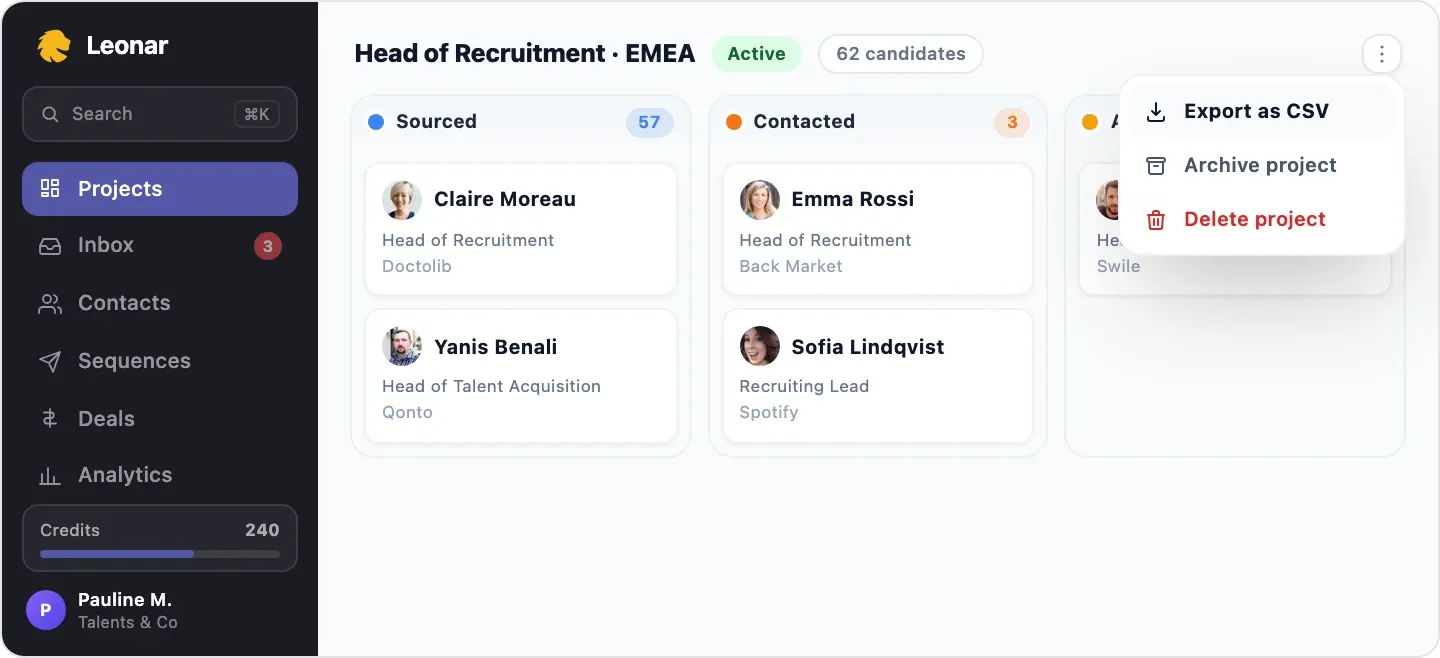
Step 4: On the top right of the project board, open the “More” menu and click on “Export as CSV”.
What changed for LinkedIn Recruiter exports in 2025 and 2026
LinkedIn rolled out several updates to Recruiter between late 2025 and early 2026 that affect how you export data. The most notable change is the new “Recruiter Advanced” tier, which replaced Recruiter Corporate for many enterprise accounts. Export limits remain similar (25 profiles per batch in-app, 5,000 unique profiles per month via CSV), but the interface has been redesigned. The new project view groups candidates by pipeline stage, which makes it slightly easier to select specific cohorts for export.
LinkedIn also tightened enforcement in 2026 against tools that automate activity on LinkedIn or copy profile data. The safe position has not changed: use the export options in your own account, the Recruiter System Connect integrations described below, and a CRM that only holds the records you decided to keep.
On the pricing side, Recruiter Lite now costs $170 per month (up from $140 in 2024), while Recruiter Advanced sits at roughly $835 per month per seat. For teams that export regularly, the cost of Recruiter alone often justifies a CRM that handles import, enrichment and outreach in one place. If price is the deciding factor, our roundup of the cheapest LinkedIn Recruiter alternatives ranked by price compares six lower-cost options side by side.
How to export candidates from LinkedIn Recruiter to your Applicant Tracking System (ATS)
If you are using a connected CRM, you can keep the candidates you decide on in your CRM and then push them to almost every ATS. Check all the integrations offered on this link: available integrations
If you are using an ATS that is not in the list, feel free to reach out to us to see what we can do 😊
If you are not using a connected CRM, LinkedIn Recruiter offers a feature called Recruiter System Connect (RSC). Only some ATSs can be integrated with Recruiter, but when yours is, this is the official route. Check these two links to see how candidates can be exported to your ATS through LinkedIn Recruiter’s own feature:
-
Export candidates to your Applicant Tracking System (ATS) with RSC: Export candidates to your ATS with RSC
-
ATS integration in Recruiter: ATS integration in LinkedIn Recruiter
A controlled workflow
Use exports and connections available under your contract, then centralize the data you exported.
Centralize multichannel outreach, prepare follow-ups, and keep control of the actions available in each account.
Answer 3 quick questions and we will recommend the best option for your hiring workflow.
How large is your recruiting team?

Author
André FarahCo-founder
André Farah is co-founder of Leonar, where he leads product strategy for the recruiting platform. With over 8 years of experience in HR technology and recruitment process optimization, he specializes in designing sourcing workflows, outbound sequences, and candidate engagement systems. André works closely with staffing agencies and in-house talent teams to build repeatable hiring processes that scale. He regularly shares insights on Boolean search techniques, multi-channel outreach, and the operational side of modern recruiting.
Related articles
-
 LinkedIn Recruiter
How to Use LinkedIn Recruiter: 2026 Guide
-
 LinkedIn Recruiter
LinkedIn Recruiter Search Filters Guide (2026)
-
 LinkedIn Recruiter
LinkedIn Boolean Search for Recruiters (2026)


